
In our oh-so-evolving landscape of search, one truth has become too loud to ignore: brand authority matters. Whether you’re optimizing for traditional search engines, AI Overviews, or large language models, brands that are well-known and trusted consistently outperform smaller competitors.
But brand authority isn’t reserved for market leaders with unlimited budgets. Even as a small player, you can build meaningful brand presence through strategic, consistent effort.
This guide introduces the SEO brand authority triangle – a practical framework built on three core areas: creating brand-aligned content, controlling your narrative across the web, and culling what doesn’t serve your positioning.
What is brand authority?
Brand authority refers to the standing, recognition and trust of a brand with the greater public.
In SEO, brand authority was most notably formalized by Moz as a measurable score, while Google’s Quality Rater Guidelines and E-E-A-T gave it further theoretical grounding. Together, the two pushed the concept into something bigger, but evasive and hard to pin down.
As SEOs, we’re used to tackling evasive stuff that’s hard to measure (hello, attribution!). And we’ve noticed a pattern: brands that are better-known and loved by more tend to perform better in organic search (see below).
Their new pages rank faster, even for topics slightly outside the core offering. Visibility and organic traffic are more stable than those of smaller competitors. Hence why brand authority has become an important concept for people working in SEO.
Closely interlinked to brand authority are the concepts of topical authority (dominating the canon, proving knowledge over a certain topic and subtopics) and domain authority (the standing of a domain, partly to do with age).
We’ll touch upon topical authority briefly in this article, but I’d also recommend these resources:
- How to measure topical authority [in 2025]
- Importance of Topical Authority: A Semantic SEO Case Study
- Multilingual SEO: Building topical authority across languages
Brand authority’s impact on SEO
If you’re working in SEO and its derivations (GEO, LLMO, AEO, AIO, – did I forget any?), you cannot afford to miss out on brand authority.
Many of the usual KPIs in organic search correlate with brand authority one way or another.
- Rankings in traditional search
- Visibility
- Traffic
- Conversions/conversion rate
- Mentions in LLMs
A study by Ahrefs, for example, showed a strong correlation between brand signals and appearance in Google AI overviews.
Additionally, Kevin Indig found brand search volume to be the one factor most strongly correlated with visibility in AI search.
Google’s big brand bias has been suspected and then half-confirmed for a while. Google’s Quality Rater Guidelines place a great amount of emphasis on E-E-A-T, a concept which decodes brand signals.
In addition to all that, people are also more likely to click on and buy from trusted brands. Trust is formed to some extent by familiarity (mere exposure effect).
To put it bluntly: the more a brand pops up on your feed, the more you begin to trust it, largely unconsciously. By surfacing already well-known brands more, Google and other search engines widen the gap between smaller and bigger brands.
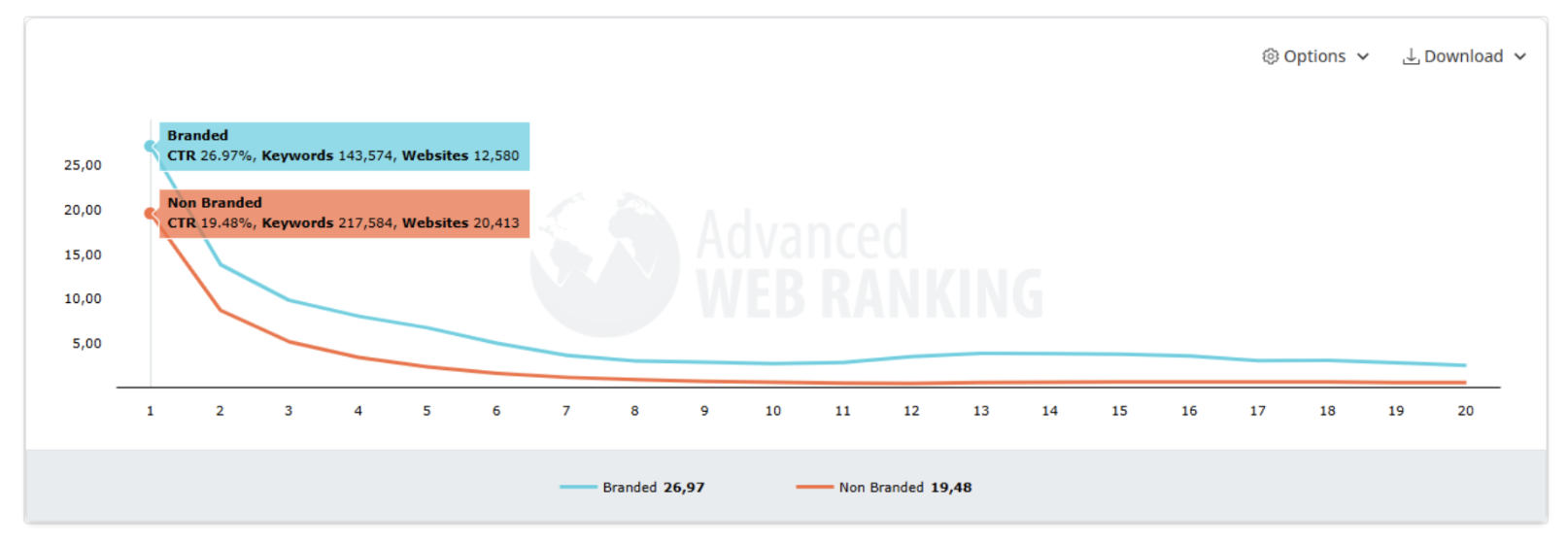
Source: Advanced Web Ranking
While the outlook for a small brand is certainly tougher than it was in Google’s early days, all hope is not lost. It is still possible to break into a saturated market as the smallest of players.
If you’re looking for inspiration, read my case study on revolutionizing the house plant e-commerce market in Switzerland and Germany.
I designed the following framework specifically with brands that aren’t already dominating the market landscape in mind.
By using SEO as a growth channel and following the steps outlined below, you will be able to build your brand presence online and send consistent signals to Google and other search engines.
The SEO brand authority triangle
While building a brand is certainly not the sole responsibility of an SEO (how could it be?!), you’ll make your work life easier by focusing on telling a consistent and favorable story about your brand.
I’ve found that there are three areas that allow you to do so. I’ve coined them and their relationship the SEO brand authority triangle.
It looks like this:
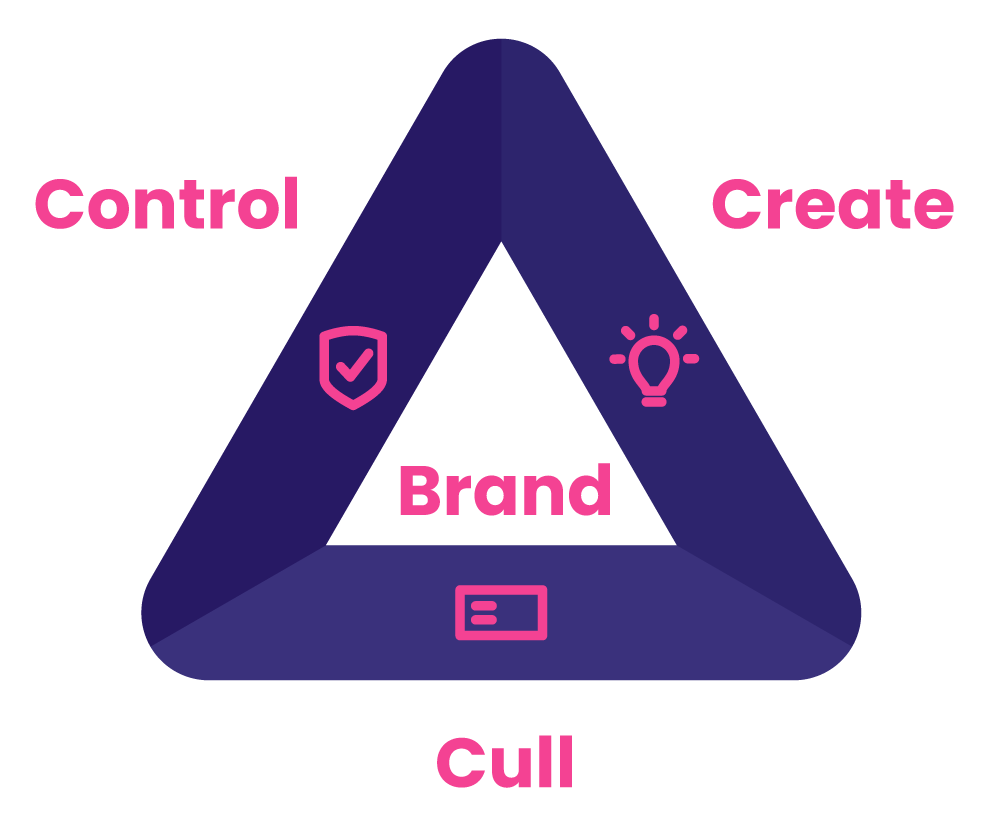
- Create content that fits the brand
- Control sources and what the web says about us
- Cull what doesn’t fit into the narrative
Even though brand authority is created, to a great extent, off-page, this approach allows us to take matters into our own hands. It enables us to influence all the factors within our control, with reasonable time and effort.
Keep in mind that the weighting will depend. If you’re building a completely new brand, for example, you’ll focus on creating content, while quickly reaching out to third parties and building your reputation off-page.
Read on to find out how you can apply the SEO brand authority triangle to an existing brand.
Breaking down the triangle: SEO brand authority tactics
Let’s start with the core of the SEO brand authority triangle, the brand.
Understand the brand positioning and USPs inside out
It is impossible to build brand authority without knowing the vision, mission, and values behind a logo and a name.
Too many SEO writers start with keyword research and subsequently map out topics the brand should cover. These are important steps in their own right; however, you’re bound to produce soulless fluff if you do not begin by truly understanding the brand.
First, follow the paper trail. The following elements may or may not exist in the company and sometimes they go by different names. Try and grab as many as you can:
- Vision
- Mission
- Values
- USPs
- North star
- Tone of voice
- Branding kit
- Messaging guide
- CI/CD (Corporate Identity/Corporate Design)
- Sales handbook
- Recorded sales calls
- CRM notes
- Customer FAQs
- Support tickets
- Standard support answers
- Personas
- ICP
- Target group
- Sales decks
- Customer interviews
- Customer reviews
- Competitor research
- Product specs/documentation
Basically, you’re trying to gather brand positioning from various sources, not just what it says in the “official” documents and on the website. Anything you can find out about target groups, customers and competitors will come in handy.
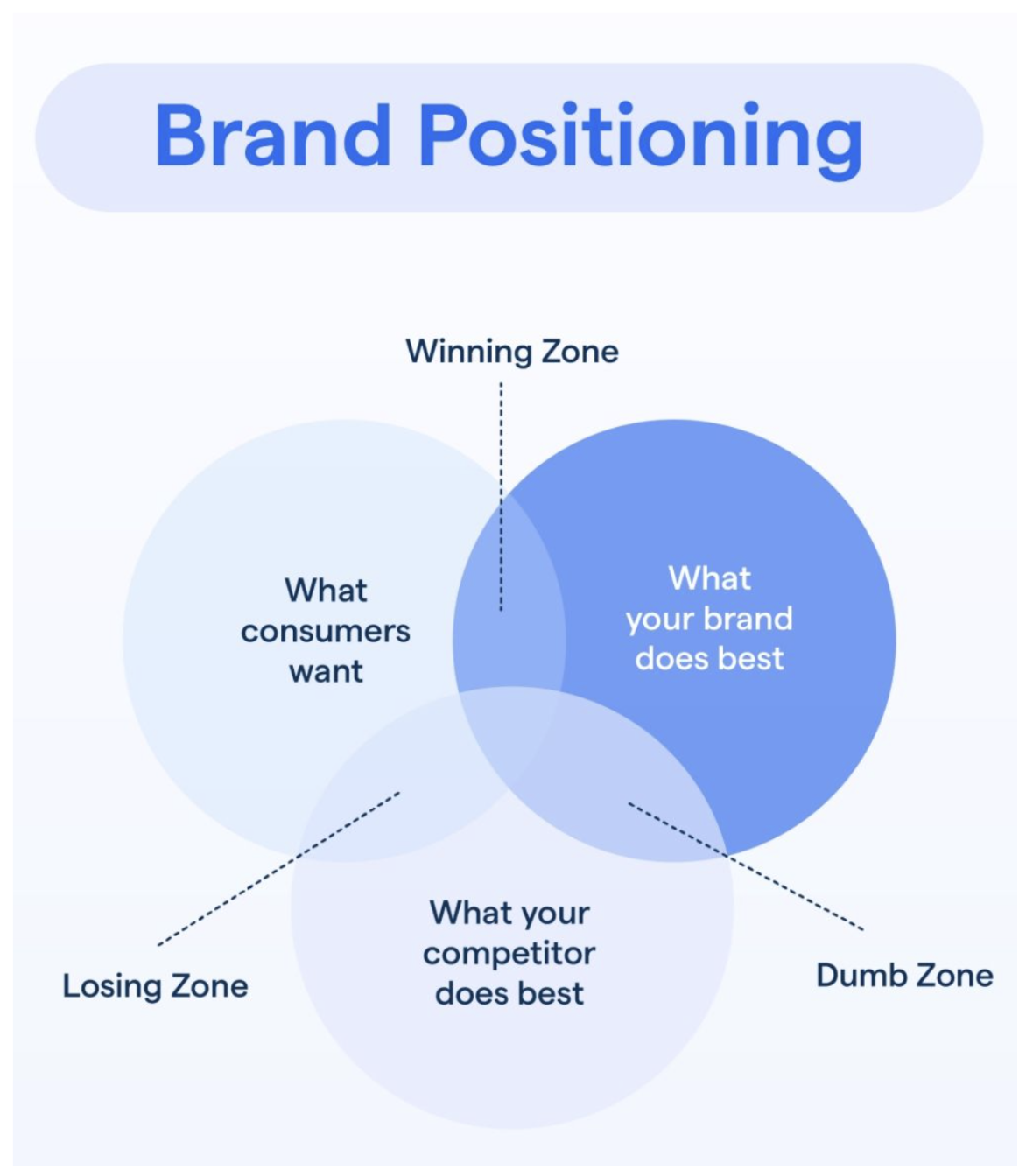
Source: BotPenguin
Second, get talking. Go ahead and schedule meetings with people from different departments, the most important ones being:
- CEO/CMO (if possible)
- Sales
- Product management/development
- Customer support
Prepare and ask smart questions (LLMs are your friends here). Your goal for both these exercises is to identify recurring topics and boil them down to what makes the brand unique and helpful.
Building brand authority will come down to applying the brand lens to anything you work on after this. You’ll be speaking from a place of USPs (unique selling points) to actual customers and prospects with real problems (more on that below).
Creating brand-aligned content
Optimize all owned channels to portray a consistent image of the brand
Starting with the website, look at where you’re talking about the brand. Unlike traditional SEO that might be focused on the blog and resource section first, the usual suspects for brand authority look a bit different:
- Homepage
- About us
- Services
- PDPs
Move beyond the website to other owned channels. Don’t forget:
- Paid search
- Email marketing
- Social media
- PR materials
- Google Business Profile, Bing Places
Now, are all owned channels saying the same thing? Are they all reflecting the USPs and the brand’s uniqueness? If not, start mapping out which topics are missing and what feels off. We’ll sync that with completely new topics shortly.
Also, check the following elements for consistency across channels:
- Brand name
- Logo
- Phone number
- Address
- Product and service name(s)
- Claim(s)
- Website URL
Cover all relevant user questions and concerns in your content
Get ready to scour through the resources you gathered at the beginning of the process. What customer/prospect pains, concerns, motivations are continuously showing up? Extend your research, even if it’s a small brand and ESPECIALLY if you’re a new-ish brand.
Look at search behavior (People Also Asked, Autocomplete, Related Searches), community platforms (Reddit, Quora, industry forums), and owned properties (internal search, review sites, social comments).
For social media, there are tools like buzzabout.ai or keywordinsights.ai that offer great insights from a variety of sources.
In Search Console, look for questions with a regex like this:
(?i)^(how|what|why|when|where|which|who|whom|whose)
Check both branded and non-branded questions.
If the company works with personas, use them to prompt your favorite LLM with the questions and concerns your personas are likely to have and how they’d ask.
Once you’ve extracted brand-relevant questions and concerns, cluster them by topic and create a content and publication plan:
- Is there existing content related to any of these that could be expanded – inline or with an FAQ section? Check if any pages are already ranking for any of the terms and questions and if that’s the page you’d like to rank.
- Which content would have to be created from scratch?
- What’s the right format for that content (blog, footer page, FAQ, returns policy etc.)?
- Do any of these content pieces need to be linked more prominently, for example from the navigation?
- Which of these would be better answered (or should also appear) on third-party sites?
- If so, on which websites?
If you’re based in the U.S., you can use Sparktoro to uncover the platforms on which your target audience spends time.
Speaking of audiences: Is there content for all audiences and personas?
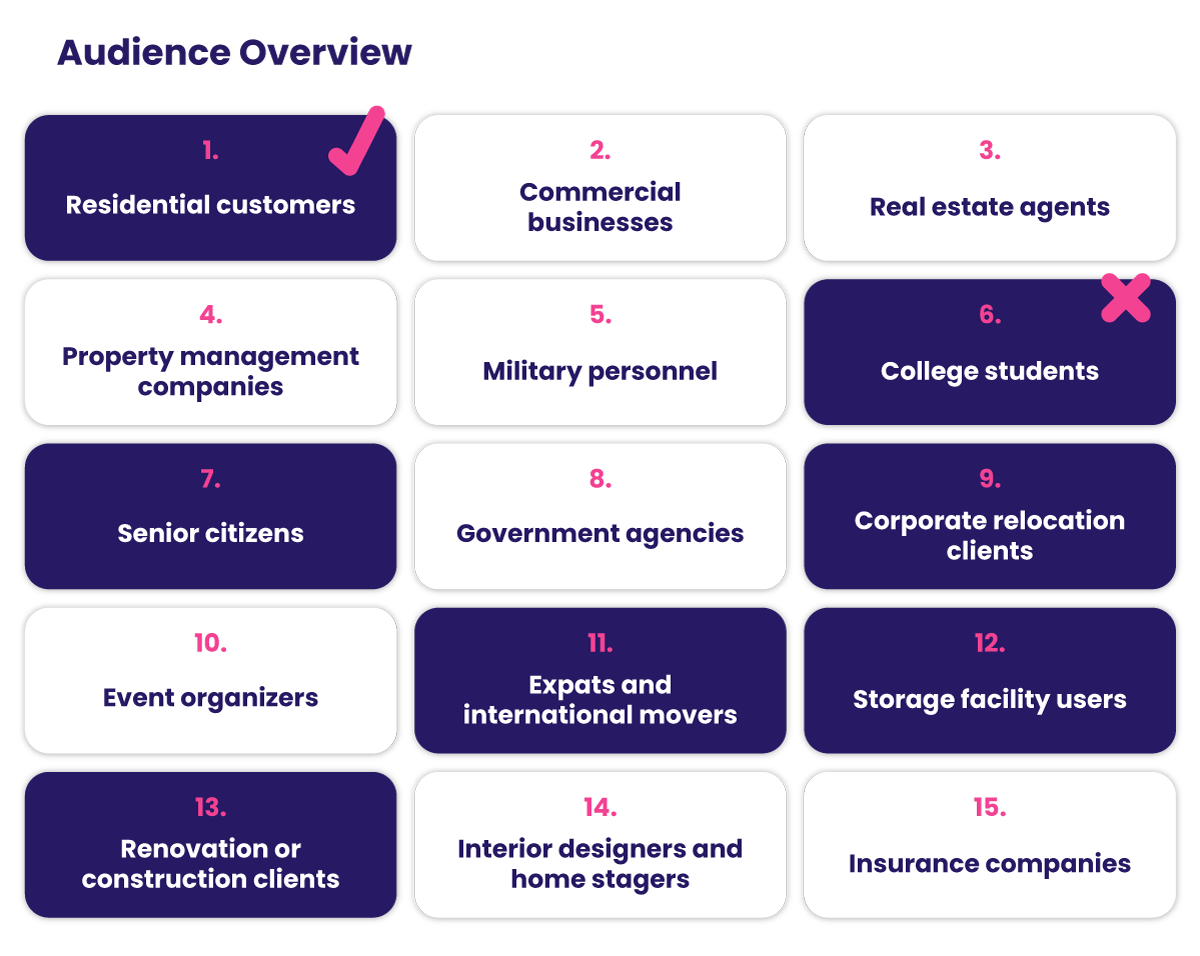
If that’s a question you can only answer with a definite 🤷, use a tool like Inlinks’ Audience Finder to discover audiences you might not have thought of.
Below is the audience profile of one of my recent clients, some of which neither I nor my client had thought of.
Now, create the content.
Keep in mind, people are going to ask about a brand online before purchasing anything from them.
If you don’t talk about the pains people associate with your brand or product and answer the questions they have, someone else will. Consequently, what surfaces in search will be out of your control.
Owning your brand story is answering those questions and concerns on your website and other owned channels.
Build out the positive aspects of your brand
While you’ve extensively dealt with user questions and concerns, you will hopefully have uncovered positive voices and raving fans as well.
Collect these positive signals from ratings, reviews, testimonials, and press mentions and make use of them on your website.
Pro tip: Link to these external sources as an extra incentive for LLMs. Mentioning them in your content is what you need to do in order to nail entity SEO.
Make sure basic quality checkmarks are in place on your website, too. That includes providing a full address in the imprint, payment options, shipping & returns, easy and simple contact possibilities etc. The E-E-A-T guidelines by Google are a really, really good starting point.
Also, don’t forget to add structured data. For brand authority specifically, you’ll want to flesh out organization schema and use every relevant property therein.
Organization schema helps search engines and other bots get a complete understanding about the brand and verify information on related websites such as social media.
All social media profiles should clearly show that the brand is legitimate, credible, and trustworthy. Review things like profile completeness, consistency, social proof, community management and professional appearance.
As established earlier, brand authority and topical authority are inseparable and the final step on the create side of the triangle addresses exactly that.
Check your content: Is topical authority fully given?
Is the existing content covering all the topics necessary so the brand can be recognized as an authoritative source in its field?
Well that’s a tough question to answer, but here are a few steps to work through it.
Check which topics competitors are covering
Are competitors covering topics that you haven’t yet, but should? Where can you add unique value? Where are niches that you claim, but they don’t? Can you flesh them out to really own them?
Audit the existing content
Can all content be assigned a relevant cluster/topic? Tag every piece of content, social media post and resource with a primary topic. Again make sure to cover all owned channels.
Audit the volume of content pieces per topic. Does this reflect the brand values? Where are the gaps between USPs/brand values and messaging?
Optimize content clusters
Use internal linking to cluster content that belongs together. You can work with the trusted pillar page approach, but it’s not a must as long as your internal linking is on point.
Invest in truly new and innovative thought leadership content
You’ll want to create data-driven content, ideally from business internal sources. A few data points for unique statistics are:
- Number of customers
- Number of years in operation
- Money saved/generated
- Number of sales
Studies and industry reports are one of the best ways to gain media coverage.
Don’t worry if you’re short on ideas, just ask your favorite LLM to kickstart your brainstorming.
Here’s a list of topics I put together with the help of ChatGPT for a moving company.
| Topic / title suggestion | Visualization idea | Format / goal |
|---|---|---|
| 🏙️ The most affordable cities in Germany in 2025 | Map with rental prices per square meter (color-coded) | Follow-up article to “most expensive cities”; search traffic for cheapest city + rent |
| 💶 Where you can still afford an apartment with an annual income of €50,000 | “Affordability index” heat map | Emotional hook: real affordability |
| 🧭 Popular relocation destinations in 2025: where Germans are really moving to | Migration map (arrows/flow chart) | Virality potential: people are interested in where others are moving |
| 🔥 Rents, electricity, heating: how much ancillary costs have risen | Time series 2015–2025 | Evergreen topic, high utility value |
Work your brand, audience, competitor, and keyword research into your content planning across the website and all owned channels, filling gaps as you go.
Often, a blog or resource section on the website serves as the primary content hub. Other channels, like social media, mainly repurpose content and that’s completely fine. You strategy could be to focus new content on the blog and the YouTube channel, for example.
Why YouTube? Because you want to make sure to include different content formats that could be used by media and shared on socials, such as video, audio and infographics.
Plus YouTube is one of the domains most consistently and frequently cited by LLMs at the moment.
So far, we’ve focused on understanding brand, users and competitors, and subsequently creating content. While I strongly advocate for spending ample time on that, we need to take a step further and start influencing the brand narrative on other platforms.
AI’s perception of a brand especially relies heavily on third party content. Therefore, building your brand authority requires looking elsewhere on the web.
Controlling your narrative
Understand how search engines and LLMs perceive your brand and where the knowledge gaps are
Even if you’re not currently optimizing for visibility in AI search (which is valid, by the way), turning to LLMs is a great way to understand if your brand story is really told consistently across all channels.
Use Aleyda Solís’ AI Brand and Product Visibility GPT to learn what ChatGPT can find out about your brand. Check the sources it uses and optimize those, especially if you find false information. The GPT will also allow you to measure the brand story against competitors and identify gaps.
Use other LLMs and ask similar questions, such as: Why would you buy X (product) from Y (competitor) instead of Z (your brand)?
There are AI visibility tools that go beyond prompt tracking and instead map your brand’s visibility against competitors. My current favorite is Waikay. Use it to fix false information in the provided sources, grab citation opportunities, and fill gaps in AI knowledge.
You can even go one step further and use a solution like Oncrawl’s AI Search Lens to identify which of your pages LLMs are actually visiting. By analyzing real crawl and log data, you can get a better understanding of which parts of your site are used by LLMs to generate their answers. When you know what pages they are using, you can work on optimizing the content.
Leverage entity SEO to control the narrative offsite
There has been a lot of talk recently about entity SEO and semantic SEO, but the concepts have existed for much longer.
They date back to the Panda and Hummingbird updates and Google announcing the Knowledge Graph in 2012. SEOs like Dixon Jones have been educating about these concepts for a long time.
I feel like entity SEO is entering its buzzword era, with some SEOs jumping on the bandwagon, using the term to deliberately overcomplicate things. There has subsequently been a lot of talk about the abstract concept and less about practical, useful tactics.
Let me break entity SEO down as I understand it and in a way that is immediately applicable to building brand authority.
The goal of entity SEO is that the brand and products are mentioned in close proximity to the entities/concepts you care about. For example, the brand Nike being closely related to running shoes as well as other properties like durability, comfort, stability, and energy return.
With the groundwork laid — mapped brand properties, USPs, audience concerns, topical authority, and structured data — you’re ready to build authority offsite too.
Before trying to figure out which of the words on your pages are entities and how they might be vectorized by machines, just try the following approach.
First, search for the company name and maybe location on Google to see if you have a Knowledge Panel. You can also use the Google Knowledge Graph API to see the information in a more structured way. This tells you if the brand is recognized by Google as an entity.
Second, claim the Knowledge Panel and check the details. You can suggest changes if you find anything amiss.
Next, check the company’s presence in major knowledge sources like Wikidata and Crunchbase. Verify the entries or create them, if they don’t already exist. Wikidata will tell you if the brand is present on other Wikimedia platforms like Wikipedia, so you can inspect that entry as well.
Make sure to audit your competitors’ data and follow up where you’ve fallen behind. For example, if they happen to have Wikipedia pages in three languages and you’re only present in one, this is something that could make sense to address.
Wherever you can, optimize for consistency and clarity offsite. Leave no doubt as to which brand, product, and service is being referenced.
Consider this example:
The running shoes offer excellent durability and long-lasting cushioning.
The Pro model is lighter, but it also uses a carbon plate.
It improves energy return and stability, making it ideal for long distances.
The first “it” is already ambiguous, but the meaning can be inferred from context: it is the Pro model that also uses a carbon plate.
The second and third “it” are too ambiguous: What improves energy return? The Pro Model? The carbon plate? Running shoes in general?
You can copy text passages from third party platforms that mention your brand and test them in these tools to see which entities get recognized:
If you’re not happy with the clarity of the message, try and reach out or reply with a comment, depending on the website. Have the text around the brand mention or the branded link changed to match the wording you use on the brand’s website.
Lastly, set up a system to keep track of branded links and mentions. My go to tools for this are Google Search Console, Bing Webmaster Tools and Alertmouse for brand mentions.
If you’d like to learn more about entity SEO and how to optimize for it, check out this beginner’s guide from Backlinko.
Strengthen your distribution network to build more brand authority in the future
To build offsite authority, focus on strategic brand mentions and branded links. Consider working with a digital PR agency to help you place them effectively.
Earning mentions and links will only gain in importance, and I’m all for outsourcing work if it’s worth the money. Going after mentions and links is A LOT of hard work.
If you’re not there yet, I’d recommend:
- Collating a list of publishers, magazines, platforms, publications, trade associations relevant to your industry.
- Having a spokesperson and positioning them on featured.com. Make sure they have an active LinkedIn profile – that’s where a lot of LLMs get their information on people.
- Looking for broken links on existing content pieces, where you can pitch your product or service as a replacement.
- Keeping tabs on recurring pieces like Christmas gift guides, top 10 lists for the year, and so on so you can approach journalists in a timely fashion.
- Creating an account on Reddit and Quora (if relevant) to start engaging as a user first before pushing the brand.
In general, start building a presence where your audience is.
On social media, besides collaborations, brand awareness campaigns can also be a great idea (thanks for that idea, Emina Demiri-Watson).
Culling what doesn’t serve your positioning
The last side of the triangle is the most counterintuitive: cull.
Reduce to the max: get rid of outdated or duplicate content
Owning your niche and keeping content close to the core offering has numerous benefits. Research by Amanda King suggests that consolidating content in lieu of producing new one can lead to up to 50% traffic uplift.
Within the recent context of LLMs and AI, auditing and consolidating content also becomes a brand exercise. ChatGPT doesn’t necessarily care when your article was published, so if you have old pricing models, old products, old branding still live, it could all be served as a “current” answer to someone asking what your prices are today. That is a problem on a lot of different levels.
Personally, I’ve worked with quite a few brands with a long-standing history. Their blogs and resource sections were proof of that, but some articles dated back to the early 2000s.
Even though they were obviously outdated, clients were hesitant to cull. Isn’t that evidence, after all, of building expertise over time?
Still, the few reports and case studies we have point in the other direction.
I’d recommend conducting a thorough content audit.
What hasn’t received any clicks and only meager impressions for 12 months can go.
If you’re on the fence about deleting a substantial part of your website, try segmenting the content and batch-deleting. I’d recommend working in larger chunks, as the one-by-one approach doesn’t lead to significant visibility or traffic uplifts you can use to justify your approach.
In Amanda King’s study, effects were visible after strategically reducing the number of pages on the website by at least 10%.
With duplicate content, or close-to-duplicate content, that exercise takes a bit more work, because it is about finding the overlaps in your content, and consolidating to the strongest page.
The easiest place to start is your favorite rank tracking tool (and yes, this might be Google Search Console, that’s okay), and finding your points of cannibalization.
Or if you have custom KPIs that measure your success, use that platform to find the strongest page for a given KPI and use rankings as a representative measure to find your overlaps.
Do you have three articles that rank for a broad term that may be related to a key product offering? You probably don’t need three individual articles. This is where we often see folks who were a bit too enthusiastic about keyword-specific pages about seven years ago.
And again, if you’re not sure, do it in batches. Start your second – or third – best group of articles, and give it about four weeks to measure impact.
Whether you’re getting rid of outdated content or consolidating duplicate content, do it with intent.
Like anything, content consolidation can be successful when done well. Go in with a strong plan of attack and you should see positive change.
This concludes the brand authority triangle tactics. What’s left is looking at how we can measure the brand authority uplift going forward.
Measuring brand authority for SEO
The simplest way to measure brand authority is brand search volume and its development over time. You can complement, but not replace with metrics like:
- Share of voice
- Direct traffic in GA4
- Overall visibility (for example in Sistrix)
- Impressions in GSC
- Visibility metrics on other channels (e.g. socials)
- Branded searches of competitors
In using these metrics and defining KPIs along these lines, you understand that visibility builds brand preference, which eventually results in conversion.
I’d also recommend reading Kevin Indig’s take on tracking brand authority.
A final word on brand authority for SEO
Building brand authority is a strategic, ongoing commitment to consistency. By working through the SEO brand authority triangle, you’re building something more valuable than immediate rankings. You’re betting on long-standing recognition, trust, and preference.
Quick-wins to start building brand authority ASAP
Want to see results sooner rather than later? Focus here first:
Get cited in AI Overviews
Optimize your content the way you used to for featured snippets: clear, concise answers to specific questions. Your well-ranking, bottom-of-funnel pages are your best shot at earning these citations.
Claim and optimize your Knowledge Panel
If you have one, make sure every detail is accurate. If you don’t, focus on building presence in Wikidata, Crunchbase, and other authoritative knowledge sources.
Audit and consolidate content
Don’t wait for a massive overhaul. Identify your lowest-performing content and delete it in strategic batches. Even a 10% reduction in low-quality pages can yield measurable traffic improvements.
Start tracking brand mentions now
Set up Google Search Console, Bing Webmaster Tools, and Alertmouse monitoring so you can respond to opportunities as they arise.
Educate and align internally
Get PR, social media, heck, even product on board. Brand building doesn’t happen in a silo and neither does technical SEO. Not only should you push organization schema, but also optimize for a great UX (think page speed and internal linking).