Over the past year, we’ve seen clicks and SEO traffic declining while crawler traffic powered by AI platforms has exploded. As AI-driven search becomes our new norm, understanding these new crawlers isn’t just helpful, it’s necessary. The key to understanding and tracking visibility in AI search is log analysis.
Log analysis has long been a cornerstone of technical SEO, helping SEOs track and understand Googlebot’s behavior and ultimately its impact on indexation and rankings. For AI bots, the method is the same: the same server logs, the same analysis techniques, and often the same tools.
But the story those logs tell is fundamentally different. AI platforms rely on several types of crawlers, each built for a different purpose than traditional search engine crawling. These AI bots work together to gather, interpret, and transform web content into the data pipelines that power modern AI models and interact directly in the grounding process when AI chatbots use web search tools.
AI bot log analysis: Same method, different story
Understanding what you are looking for changes the way you read your logs. When you’re tracking several bots with different behaviors and objectives, you’re no longer looking for the same things. Instead of monitoring crawl efficiency or indexation patterns, you’re now trying to decipher how multiple AI systems interact with your content and what will keep them coming back.
In this article, we’re going to look at the different kinds of AI bots, how they differ, what they do, and what you can actually learn from their activity in your logs.
Three categories of AI bots
Not all AI bots are created equal. While they all visit your website, each type has a distinct purpose. Certain bots are meant to gather data for the next generation of AI models, others are used to build search indexes, and some work in real-time to answer user’s queries.
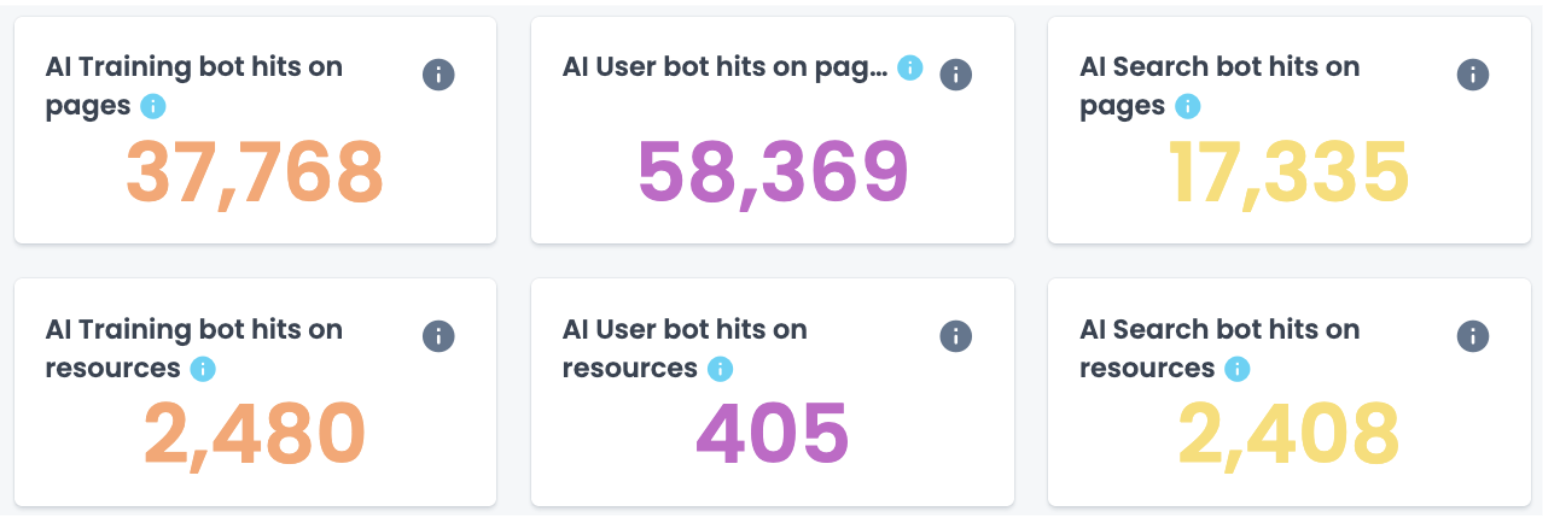
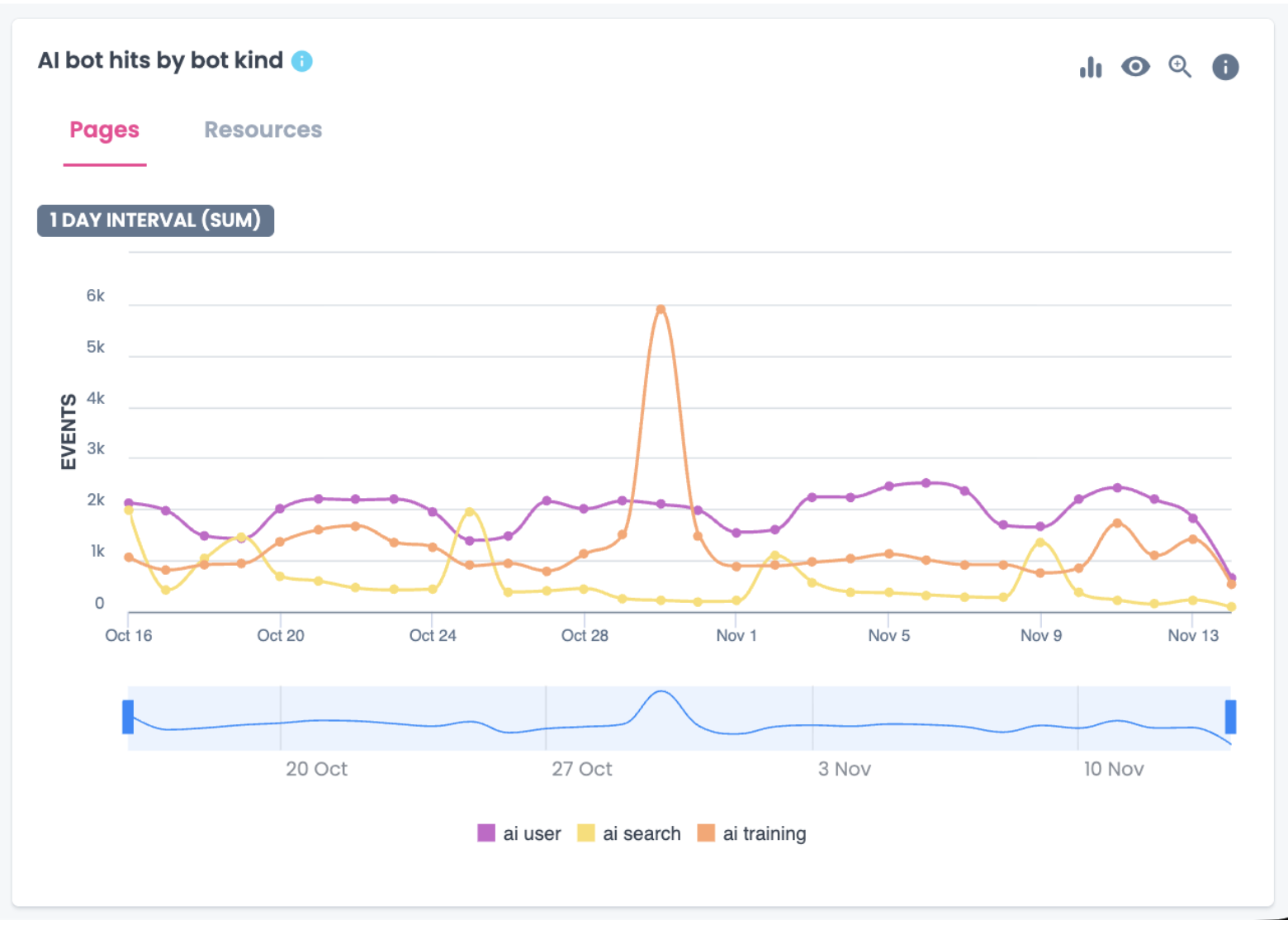
Understanding which bot is doing what changes how you interpret your log data. AI bots fall into three main families of crawlers, which are used by platforms like ChatGPT. These are the same categories you’ll see in Oncrawl’s AI bots dashboard:
| AI training bots | AI search bots | AI user bots | |
|---|---|---|---|
| Purpose | Content scraping for model training | Improving search results quality and pages indexation | Real-time content scraping for user answers and citations |
| Known user agents | GPTBot, CCBot, Bytespider, Claudebot… | OAI-SearchBot, PerplexityBot, ClaudeSearch-Bot… | ChatGPT-User, Perplexity-User, Claude-User… |
| Impact on AI search | Influences future model knowledge (delayed, months later) | Affects your inclusion in AI search indexes | Direct visibility impact (happens in real-time during user queries) |
Discover the full list of supported bots by Oncrawl’s log analyzer.
AI training bots
Crawl purpose
AI training bots crawl your website to scrape content that may be used in LLM training. Their activity reflects how AI systems gather data from your site for future model development.
These were the original AI crawlers, conceived when companies needed to collect massive amounts of content to train their models. Most collect data for their own AI platforms, but some, like CCBot from Common Crawl, act as data providers to multiple AI companies.
Crawl behavior
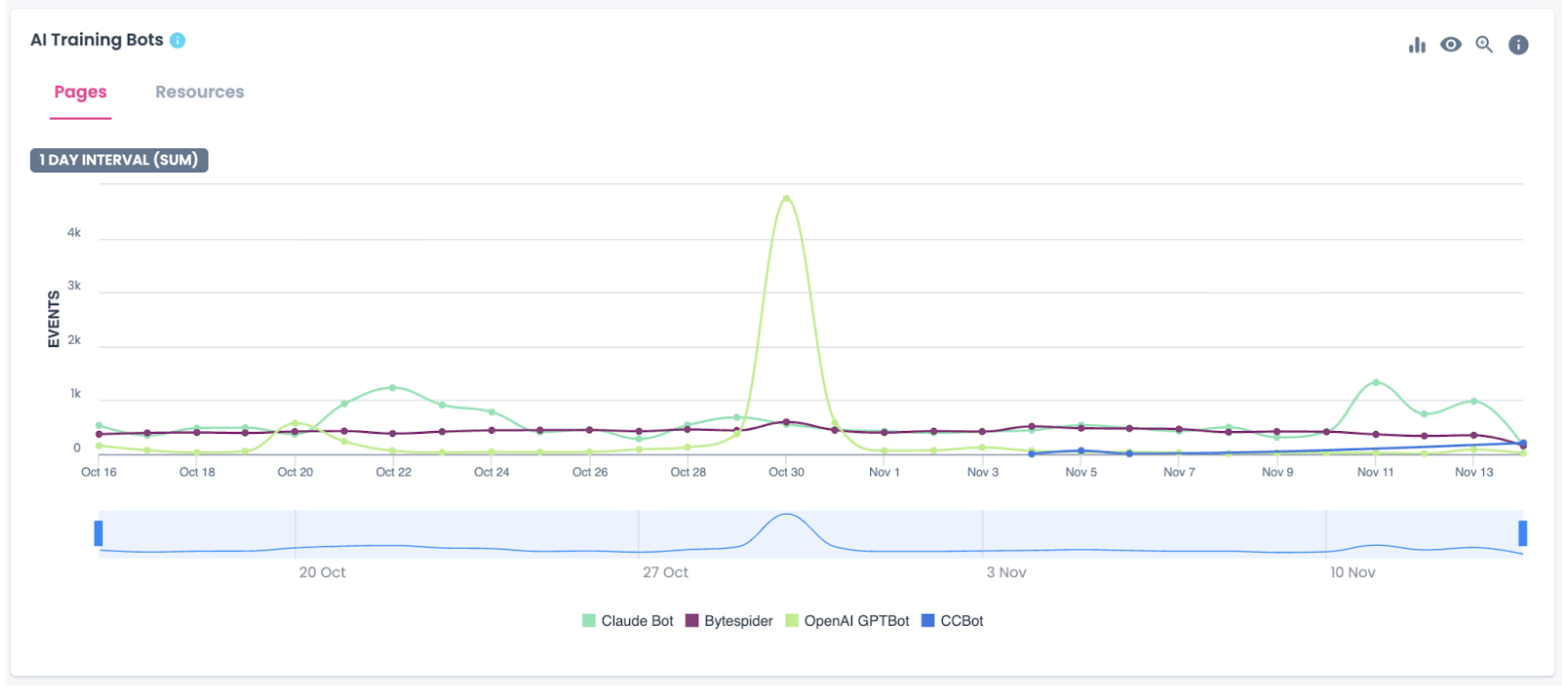
At first glance, AI training bots appear to work like traditional web spiders, following links and crawling entire domains. However, when you take a closer look at the data, you see that their behavior is far less predictable than traditional crawlers like Googlebot.
Each bot has a different crawl capacity and behavior pattern. Additionally, most don’t follow systematic patterns; they tend to crawl whatever content they can find without clear prioritization.
The main differences when compared to Googlebot:
- They don’t have a crawl budget concept
- They don’t handle JavaScript rendering
Impact on AI search
The impact on AI search is minimal in the long run.
Having your content crawled by an AI training bot doesn’t guarantee it will be used to train the LLM. In actuality, most crawled content never makes it into model training due to the extensive data cleaning pipelines. Here’s what happens between crawling and training:
| Step | What happens |
|---|---|
| Crawling | Bots collect raw web content |
| Filtering | Spam, duplicates, and low-quality data are removed |
| Classification | Topics and content types are identified |
| Sampling | Diverse, balanced examples are kept |
| Pre-processing | Data is formatted and prepared for training |
| Curation | The final subset used in the model is selected |
Beyond the filtering challenge, there’s a significant time lag. LLM knowledge cutoff updates happen once or twice a year maximum, creating months of delay between when your content is crawled and when it might influence the model’s knowledge.
| Model name | Knowledge cutoff date | Release date |
|---|---|---|
| GPT-5.1 | October 01, 2024 | November 14, 2025 |
| GPT-5 | October 01, 2024 | August 7, 2025 |
| GPT-4.1 | June 01, 2024 | April 14, 2025 |
| GPT-4o | October 01, 2023 | May 13, 2024 |
| GPT-4 | September 01, 2021 | March 14, 2023 |
| GPT-3.5 Turbo | September 01, 2021 | January 24, 2024 |
| GPT-3.5 | September 01, 2021 | March 15, 2022 |
| GPT-3 | October 01, 2020 | November 01, 2021 |
Key takeaways
You cannot correlate AI training bot activity with model knowledge updates, which limits the actionable insights you can draw from this bot category.
However, tracking these bots still provides value for long-term strategic questions:
- Can they successfully crawl your website and access your content?
- What content and resources are they targeting?
- What’s the cost (on your server or resources) of allowing them to crawl your website?
AI search bots
Crawl purpose
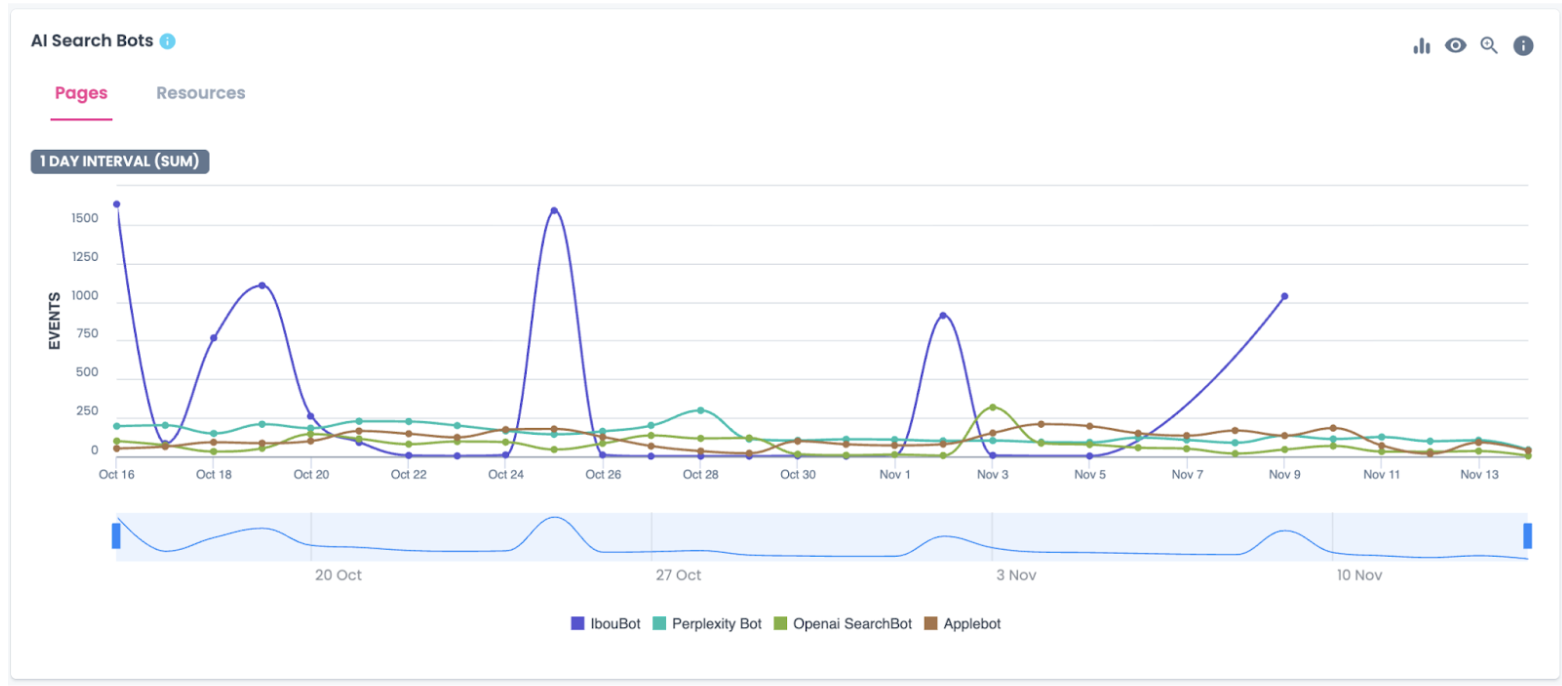
AI search bots crawl your website asynchronously for indexing and improving search results. Their activity is closer to classic SEO signals like Googlebot hits.
When AI platforms like Perplexity, and later ChatGPT, introduced search and grounding processes on top of their LLMs, they needed crawlers dedicated to search and indexing, just like Google uses Googlebot.
For platforms building proprietary indexes, like Perplexity or Ibou, these bots function exactly like Googlebot: they crawl the web to build and maintain an index of web pages.
For platforms using third-party search engines in their grounding process, like ChatGPT does, the role is less obvious. According to OpenAI’s official documentation, ChatGPT’s SearchBot (OAI-SearchBot) “is used to link to and surface websites in search results in ChatGPT’s search features.”
OpenAI’s support team confirmed that OAI-SearchBot crawls pages to improve the quality of search results and the search feature itself. But with the recent discovery of the existence of a cache index of pages and search results, this bot might also be involved in the caching system OpenAI uses for ChatGPT Search.
One commonality across all AI search bots is that they are not collecting data for model training purposes.
Crawl behavior
Unlike AI training bots, AI search bots show clear crawl patterns and take a more strategic approach to crawling websites. They don’t crawl as extensively as Googlebot and it’s still unclear exactly how they explore and discover web pages.
Two notable patterns have emerged:
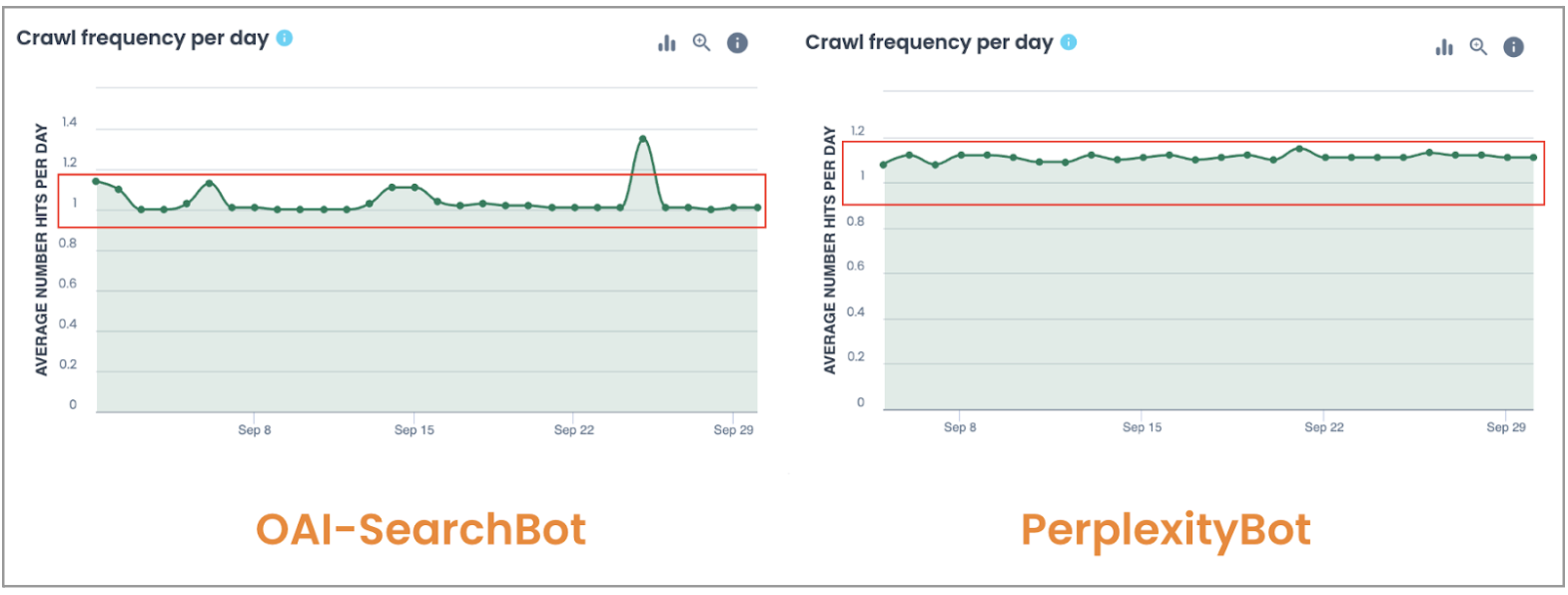
Crawl frequency per page is once a day
This crawl behavior, with an average crawl frequency of one visit per URL per day, explains why they crawl far fewer pages than Googlebot.
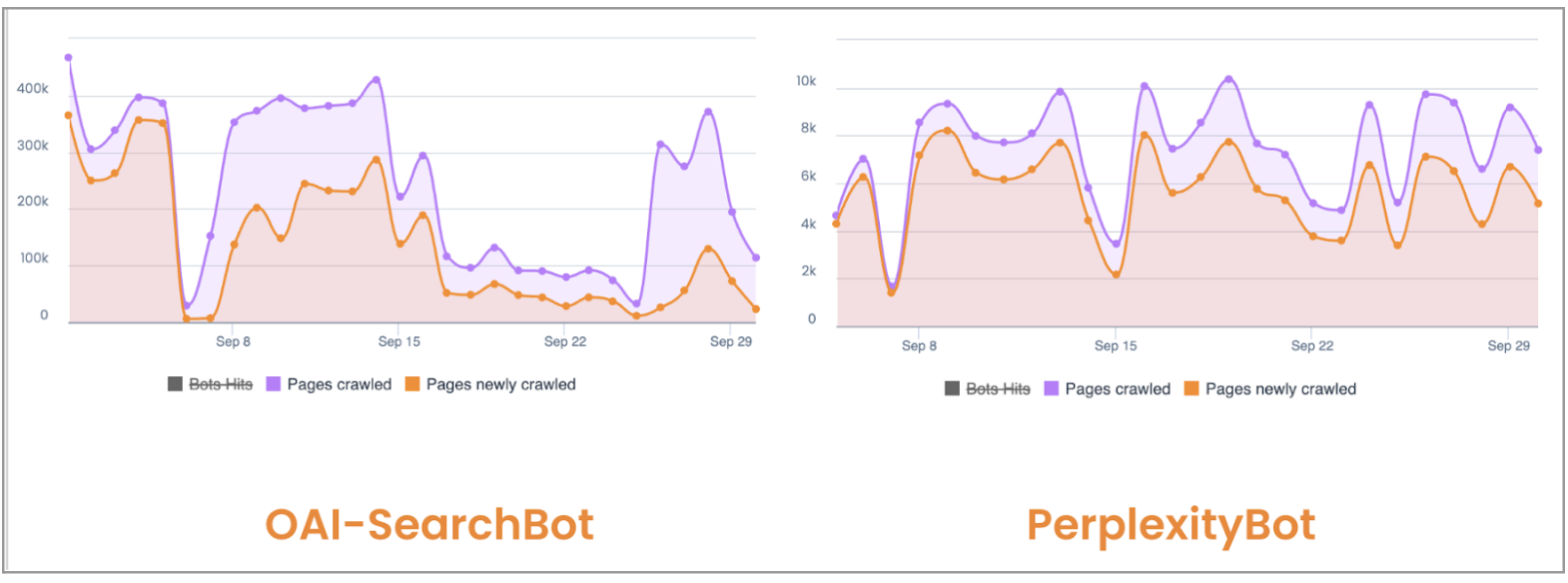
The crawl pattern favors new pages
They mainly crawl new pages day after day.
Impact on AI search
These bots are essential to the grounding process and directly impact AI platforms’ ability to surface your website in responses when users activate the search feature.
If you block these bots, your chances of being featured in results drop significantly. However, the grounding process may still access your pages through third-party search engine indexes, even if the AI search bot itself is blocked.
[Ebook] Mastering SEO in a query fan-out world

Key takeaways
AI search bots provide similar insights to Googlebot log analysis. You’ll be able to identify:
- How much of your website is crawled (coverage ratio)
- Page types that are crawled most frequently or ignored by these bots
- Pages with the highest crawl frequency (a qualitative signal of importance)
- Issues preventing access to pages:
- Status codes
- Server response times
Increasing AI search bot traffic is a positive signal of interest in your content from AI platforms. Conversely, decreasing AI search bot traffic is a warning sign that requires deeper investigation.
AI user bots
Crawl purpose
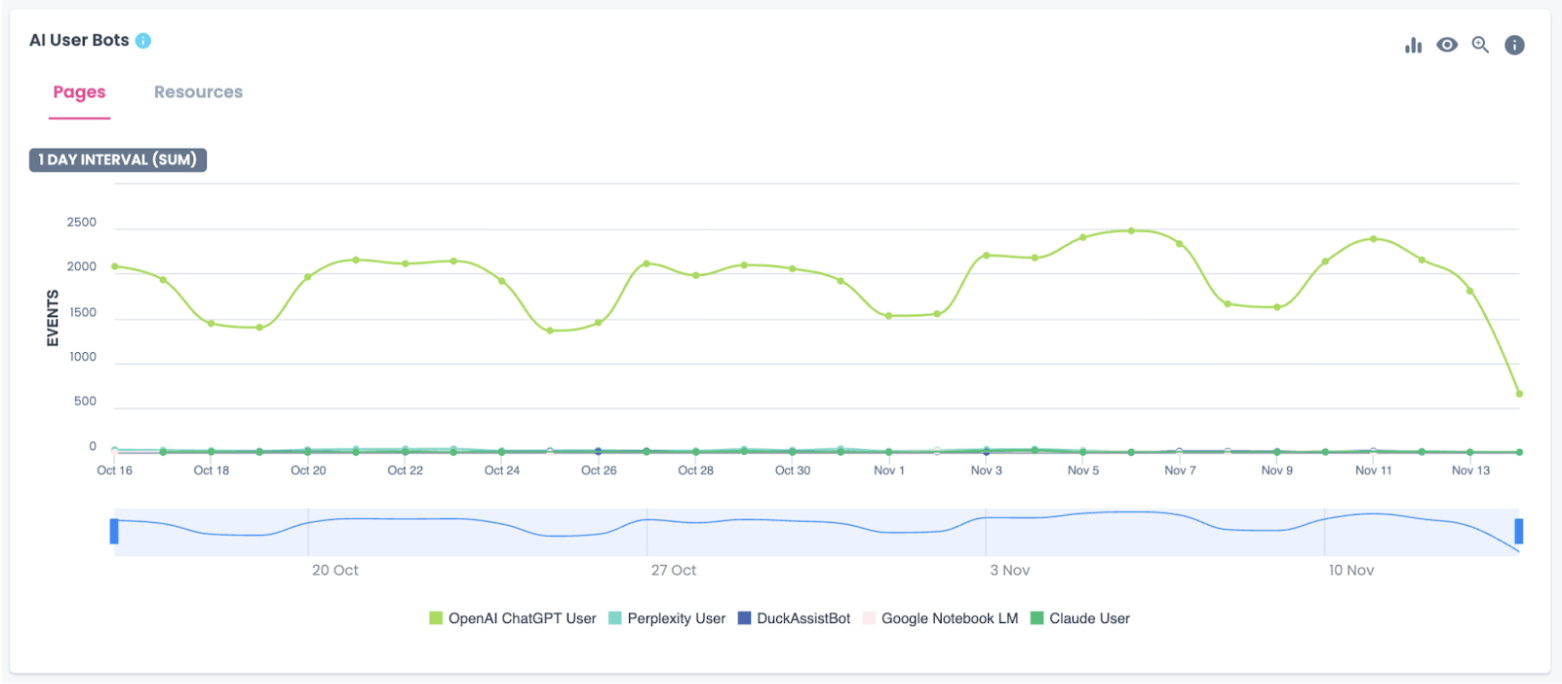
AI user bots crawl your website in real-time to find the answer to a user prompt. Their activity is a direct signal of visibility in AI interfaces and serves as a proxy for impressions.
This is where AI search gets tangible. When an AI user bot visits your website, it means a real user just triggered a search query, and the AI platform is fetching your content to answer their question.
AI user bots operate on behalf of users to scrape the content needed at the final stage of the grounding process:
Prompt → Query fan-out → Search results → Content scraping → Response → Click
Just like AI search bots, these bots are not collecting data for AI training purposes.
Crawl behavior
AI user bots don’t crawl in the traditional sense. They fetch a single page on demand without following links, though they do follow redirects.
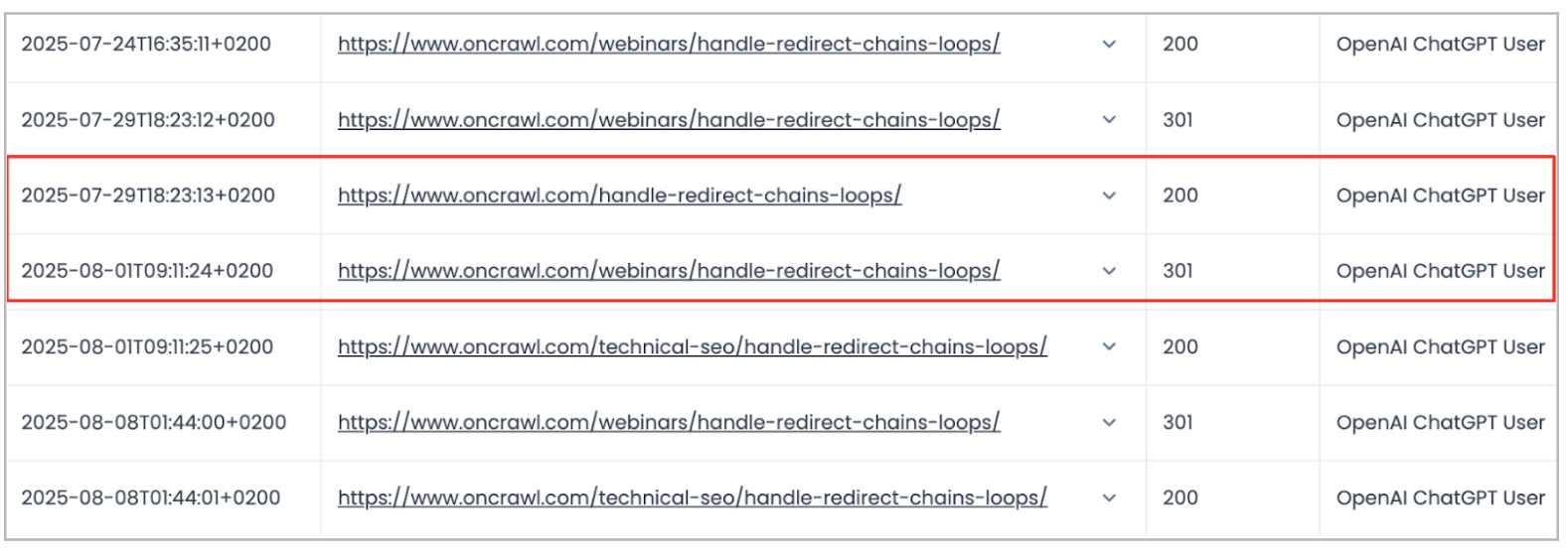
Their behavior is directly linked to AI chatbot user activity. When people ask questions that require a search to answer, AI user bots, like ChatGPT-User, visit websites to retrieve the necessary content.
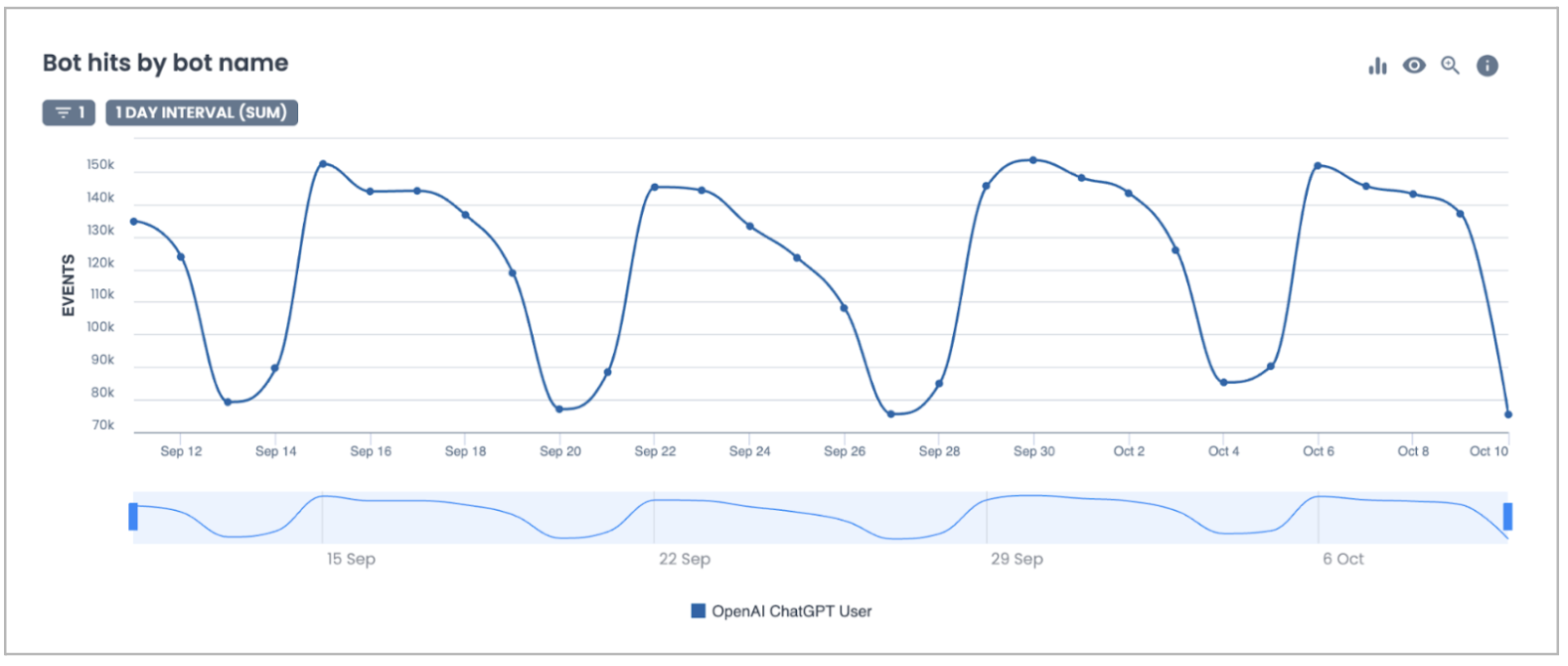
ChatGPT-User weekly crawl behavior
If you focus on ChatGPT-User, you can spot a week-by-week pattern that follows typical SEO traffic trends, with noticeable drops during weekends.
ChatGPT-User daily crawl behavior
If you zoom into daily patterns, you’ll see traffic drops during nighttime hours, much like traditional SEO traffic.
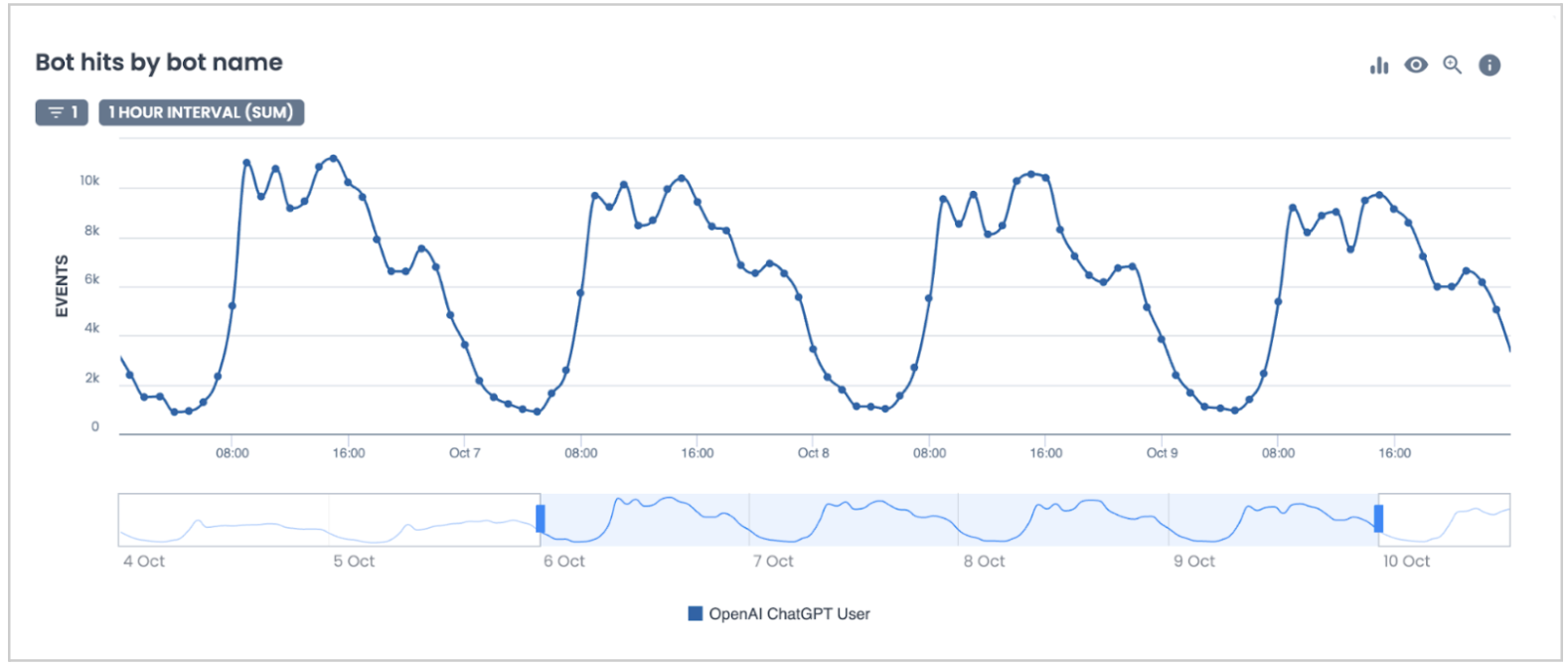
This correlation between AI user bot activity and AI chatbot prompt activity means you can use AI user bot visits as a proxy for impressions or prompt volume to measure your visibility in AI platforms.
User bot hits ≃ impressions
Impact on AI search
AI user bots are the most valuable bots to track for measuring and understanding AI search. They open the AI black box and help you measure your website’s visibility in the zero-click era.
Visits from AI user bots serve two critical purposes:
- Measure and report your efforts: Track visibility as a KPI over time
- Explore and find insights to improve: Identify what’s working and what isn’t
Unfortunately, this approach doesn’t work for Google AI Mode and AI Overviews because Google doesn’t need to crawl in real-time. It queries its existing index instead.
Key takeaways
AI user bot visits can be used as an AI search visibility metric: a proxy for impressions or prompt volume.
For example, every bot hit from ChatGPT-User on your website represents an attempt to read your content for a citation. It doesn’t guarantee the source was actually used in the answer to a user prompt, but it confirms the page was listed in the sources. ChatGPT Search selected this page among other search results as a trusted source likely to contain the information needed to answer the prompt.
Using bot hits from AI user bots, you’ll gain insights into:
- Which pages AI platforms fetched to answer real user questions
- How many different pages are being accessed and how often
- Which pages are fetched by AI platforms versus those never accessed
You can track this over time, just like you track traffic, and use it as a KPI to measure your AI search optimization results. Since clicks are decreasing and AI search barely generates any, this provides a metric to open the AI search black box and measure what happens before the clicks.
Conclusion
Reliable AI search data remains one of the biggest challenges facing SEO professionals today. Log analysis offers a solution, providing the most valuable field data currently available for understanding AI platform behavior.
Tracking AI bots through your logs requires understanding their different purposes because each tells a different story. The most important bots to monitor are the two involved in the search and grounding process: AI user bots and AI search bots. Both provide ways to report results and uncover actionable insights.
In the next article, we’ll explore how to turn AI user bot visits into reliable AI search metrics and examine the limitations of this approach.