A page can rank first in traditional search and still miss out on AI-generated answers.
Some SEO professionals and content teams assume the fix is another rewrite or more content. In many cases, the content already answers the question, but AI systems didn’t retrieve enough of it to build a complete answer. In that case, the real problem is discovery.
Google continues to use query fan-out for AI Mode and AI Overviews. So, instead of running one search, it breaks a question into several related searches across different subtopics and data sources, then builds a response from the results.
Some content teams respond to query fan-out by covering more subtopics. They build topic clusters, publish more articles, and cover every related question a keyword tool can surface. Those are sensible improvements, but they solve only part of the problem. The rest of the problem sits below the content itself. You can spot it by asking two simpler questions:
- Can crawlers discover the subtopic pages you’ve built, and can AI systems retrieve them when it matters?
- Do internal links connect clusters into one clear subject or are important pages buried several clicks from the homepage?
Content quality earns a page its place in an AI-generated answer, but only if your site’s structure lets AI systems reach it.
What query fan-out demands from your site
One query becomes many searches before it becomes one answer. Think about someone searching, “How do I improve my LinkedIn engagement?”
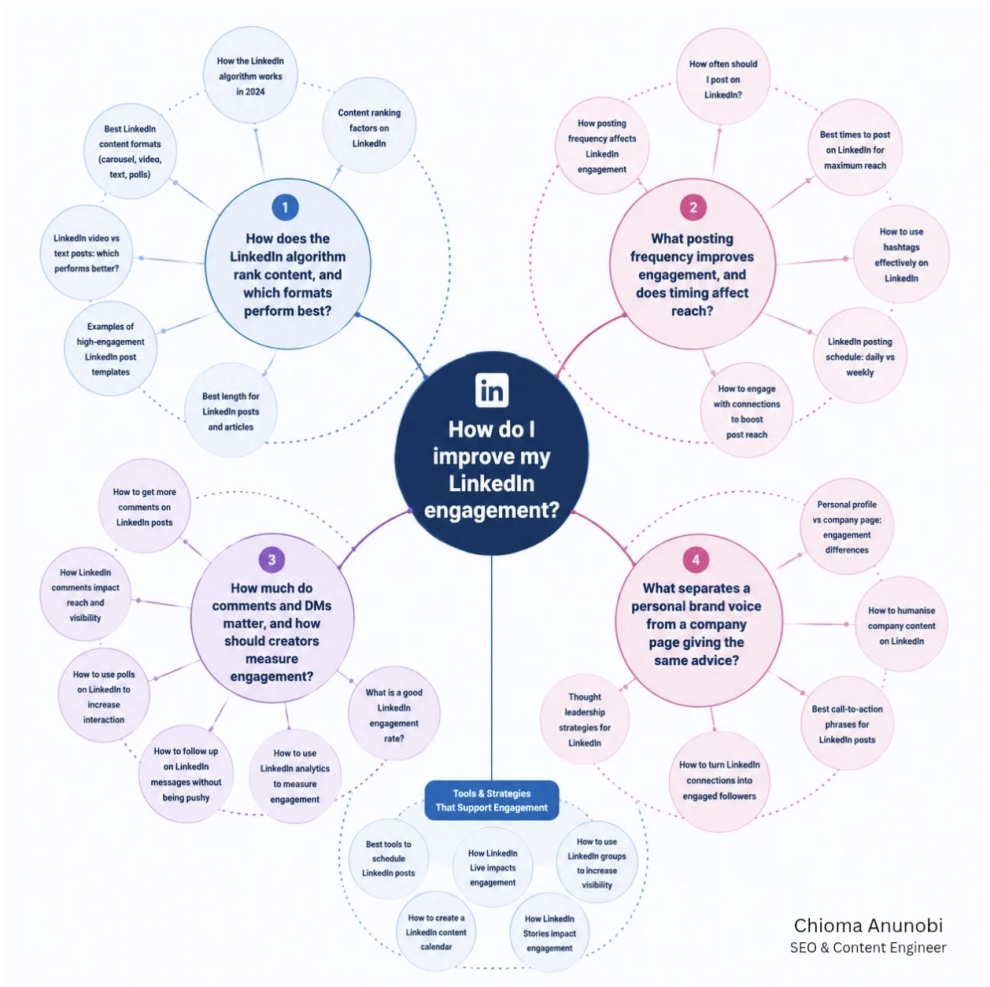
Behind that single-line query, the system checks several related questions at once.
- How does the LinkedIn algorithm rank content, and which formats perform best?
- What posting frequency improves engagement, and does timing affect reach?
- How much do comments and DMs matter, and how should creators measure engagement?
- What separates a personal brand voice from a company page giving the same advice?
Each sub-query becomes its own retrieval step, run in parallel, before the system builds a final response.
Ranking for one broad keyword still matters, but AI visibility now depends on whether your site collectively answers the questions clustered around a search.
Supporting pages, detailed guides, examples, and reference content all become valuable retrieval points.
Avoid creating a separate page for every fan-out variation solely to influence AI responses. Instead, build helpful, people-first content that covers a topic well.
Every fan-out search is another opportunity for your content to be retrieved. If a topic fans out into eight or ten related searches, three orphaned, blocked, or buried pages can sink a chunk of the answer. That reduces the evidence available before content quality even gets assessed. To avoid that problem, the first step is making sure your content is crawlable.
Crawlability determines what content AI can retrieve
A page can return a 200 status code and still be invisible to both classic and AI retrieval. Don’t confuse crawlability with discoverability. A crawlable page can be accessed by a search crawler, return the right status code, and load correctly. That’s the technical foundation.
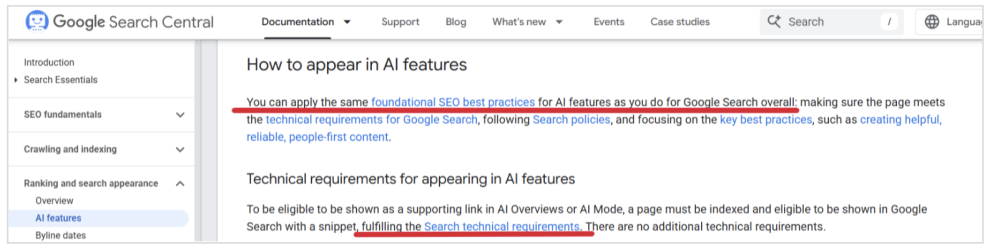
Google highlights that AI features use the same foundational SEO requirements as classic Search, including crawlability and indexability.
For a page to be discoverable, it needs strong signals telling crawlers it deserves attention. Internal links, navigation, XML sitemaps, and a logical site structure all guide crawlers towards important content.
For example, a page linked only from a category page and left out of the XML sitemap can still be crawled but it’s much harder to discover. Good content still needs a clear path.
Search systems spend their crawl resources where they find the strongest signals. Pages buried deep within a site receive less attention than pages connected through clear internal links and navigation.
What prevents content from being discovered?
Several technical issues can weaken discoverability, including:
Blocked AI crawlers
Some websites block AI crawlers, knowingly or not. Access is the first requirement and can be easily overlooked. John Iwuozor, a Content Lead @DualEntry, shares what this can look like in reality.
John Iwuozor
Content Lead @DualEntry
“Crawlability is one of the biggest issues. Some websites block AI crawlers from accessing their content, sometimes through robots.txt.
If crawlers such as ChatGPTBot, ClaudeBot, or PerplexityBot cannot access a page, that content has less opportunity to be retrieved for AI-generated answers, regardless of how good it is.”

When a crawler has to work harder to reach supporting resources, retrieval suffers.
Weak site structure and crawl paths
Deep crawl depth, orphan pages, weak navigation, and incomplete XML sitemaps can make important content harder for crawlers to discover. Redirect chains and other inefficient paths also waste crawl resources and slow discovery.
Rendering and access issues
JavaScript-dependent content adds a rendering step for Google. Most AI crawlers, such as GPTBot and ClaudeBot, don’t execute JavaScript at all, so links or content that only appear after scripts run may never reach them.
Measuring retrieval gaps at scale
Finding these issues is manageable across a small website. However, when you have to look at hundreds of thousands of URLs, it isn’t.
Oncrawl helps you see how a site’s technical structure affects discovery by identifying your issues at scale, such as:
- pages buried too deep within the site
- orphan pages with no internal links
- JavaScript rendering issues
- indexability problems
- redirect patterns
- internal linking relationships
- crawl depth across the entire site
Looking at these signals together helps answer the real question: are search systems reaching the pages you expect them to use?
When combined with log file analysis, AI Search Lens connects AI bot crawl and fetch activity with estimated citation signals and referral traffic. It helps you understand which pages AI systems discover and request, and whether that activity leads to visits from AI platforms.
When the content exists but crawlers can’t find it
Missing AI visibility can look like a content gap, and the response is to cover another subtopic. But sometimes the content already exists, and the problem is that the pages answering those related questions aren’t easy to discover. Here are three ways that can happen:
The page got cut off as the site grew
A page can start out as part of a clear topic cluster and become disconnected as the site expands. New categories, navigation changes and layers of content can push older pages further away from the main paths through the site. The page still exists and may still answer an important subtopic, but its place in the site’s structure has been lost.
The page is written, just buried too deep
A page can answer a fan-out question well and still sit several levels down from the homepage, with few internal links pointing towards it. On larger sites, crawlers have a limited amount of time and resources to spend. A deep page with weak internal signals can be harder to discover and revisit than one connected to stronger, more accessible paths.
The page exists but nothing links to it
An orphan page is live on the site but has no meaningful internal links pointing to it. It can exist in the CMS, appear in a sitemap or be accessible through a direct URL, yet remain disconnected from the site’s main navigation paths.
The content has been published, but the site’s internal structure gives crawlers little context or reason to reach it through the pages around it. These are discovery gaps rather than content gaps. The distinction matters even more when AI search needs to find several supporting pages around a query rather than relying on one document alone.
Internal links as semantic pathways between sub-queries
Internal links have long helped search engines discover pages and understand their relative importance. In AI search, they communicate topical relationships, connect supporting evidence, and show how individual concepts fit under one broader entity. That matters to how retrieval-based systems decide what to cite.
Take a structure where the homepage links straight out to a technical SEO article, a product update, and a hiring page. All three share the same navigation row with no topical thread between them. There’s no page explaining how they relate, no cluster tying the technical SEO article back to anything else on the subject.
AI systems fanning out a technical SEO query find no signal connecting these pages to each other. To a person, that’s fine, but to a system, it appears as three unrelated facts that happen to share a domain.
Now compare that with a technical SEO pillar page linking out to crawl budget, log file analysis, sitemaps, internal linking, and JavaScript SEO. Each of those pages links back to the pillar and sideways to each other, so a reader, or a bot, moving through any one of them keeps landing on related material.
That bidirectional pattern shows a connected ecosystem rather than a scattered list of posts. When a fan-out query asks specifically about crawl budget, the cluster gives the system several related pages to draw supporting evidence from, instead of one page standing alone.
Tobi Akinrinmade, a digital marketing specialist, said when auditing a site, he compares how pages are represented in the sitemap with how they are discovered through a crawl.
Tobi Akinrinmade
Digital marketing specialist
“I would normally compare the XML sitemap against a crawl of the website.
If an important page exists in the sitemap but isn’t being discovered through the crawl, that is an immediate red flag.”

He also assesses whether related pages are connected through contextual links, rather than simply existing alongside one another.
Finding fan-out gaps in your crawl and log data
Start by asking a few questions about your own site before deciding where to focus.
- Which pillar pages have important supporting content buried too deep? Supporting articles that are four clicks from the homepage are less likely to contribute when AI systems retrieve information for a pillar topic.
- Which supporting pages receive no meaningful inbound internal links? Finding orphan pages or weakly connected resources is one of the quickest ways to improve retrieval without creating new content.
- Does crawler behavior reflect your content priorities? If high-value pages such as product hubs, pillar guides, or service pages get little crawler activity, your technical signals may not reflect your business priorities.
- Are AI crawlers reaching the pages your fan-out strategy depends on? Google’s AI features rely on Googlebot, but ChatGPT, Claude, and Perplexity send their own crawlers. As AI search grows, you need visibility into how AI crawlers interact with your site.
Crawl data maps every page a bot could theoretically reach. It flags orphans and pages buried too many clicks deep. What it can’t show is whether anything visited those pages in practice. In contrast, server logs record every request a bot made, not just the paths a crawl says exist.
Once you’ve identified the pages supporting a fan-out topic, the next check is whether search and AI crawlers discover, revisit, and connect to them as intended.
A practical framework for closing query fan-out gaps
After finding retrieval gaps, the next step is fixing them.
We use the DISCOVER framework below to guide that process. It starts with understanding the topic and ends with measuring whether your changes improved retrieval.
D: Discover the questions behind the topic
This step is research. You’re mapping the complete set of questions around a topic, not just with keyword tools. Google’s autocomplete, People Also Ask, Search Console, and real customer questions can all reveal useful supporting topics.
I: Identify the pages that already answer those questions
Check which of those sub-queries already have a page answering them, across blog posts, guides, landing pages, or documentation. You can map existing pages against the fan-out questions before planning new content.
S: Surface technical barriers
Run each page from the last step through Oncrawl and flag what’s structurally wrong with it.
Suganthan Mohanadasan, an AI SEO Researcher, co-founder of Snippet digital & Keyword insights, also recommends looking at server speed and firewall settings.
Suganthan Mohanadasan
AI SEO Researcher
Co-founder Snippet Digital & Keyword Insights
“When diagnosing issues, I always look at server speed and firewall settings first. By speed, I mean a fast time to first byte, not a generic performance score.
AI systems fetching pages for an answer won’t wait around if a server is sluggish. The connection can drop, and the system may build its answer from another source instead.”

Suganthan also points to strict web application and default CDN bot settings as potential causes of failed fetches. These settings can interfere with retrieval even when the site’s robots.txt appears correctly configured.
“I’ve personally watched ChatGPT abandon a primary source it couldn’t parse and fall back to quoting a third party for a company’s own official data.
Fix server speed and remove any accidental blocks, then test the prompt again to see who gets cited.”
– Suganthan Mohanadasan
C: Connect related pages with internal links
Review and add internal links from important supporting resources, routed through relevant pillar pages rather than the nearest menu.
O: Optimize pages that weaken the topic
Some pages still need improvement. Fix whatever the crawl flagged, whether that’s thin content, a slow load time, or missing structured data. Refresh outdated information and expand sections that answer important supporting questions.
V: Validate that the crawl paths work
The first real proof shows up once the changes go live. Review whether:
- crawl depth has decreased for priority pages
- orphan pages have been reduced or eliminated
- important pages are easier to reach through internal links
E: Evaluate how crawlers respond
Evaluation confirms that crawlers noticed those changes. Here you’re watching AI bot visits separately from Googlebot activity, along with citations and AI referral traffic where you can track them. Review log data to see whether important pages receive more crawler attention after technical improvements.
R: Repeat as the topic evolves
A topic’s fan-out shifts as products change, audience intent evolves, and new questions and formats enter a category. Re-running DISCOVER on a set schedule keeps your coverage in step with those changes.
Crawl data, log files, and performance data usually live in three separate reports, pulled from three separate tools. That fragmentation makes before-and-after tracking slow enough that many teams quietly stop doing it after the first cycle.
Bringing those datasets together in Oncrawl makes before-and-after comparisons quick enough to repeat every cycle.
Closing the gap without rewriting the content
Before planning your next content sprint, ask a simpler question first: “Can search systems discover the knowledge your website already contains?”
Closing this gap means rewiring what’s already there, so it connects to the paths that lead to an answer. Start by adding contextual links from pages that already carry authority and flattening crawl depth on your priority clusters. Then clean up the redirect chains piling up behind old campaigns and keep your sitemap focused on the pages that matter most.
AI search rewards sites that make the right information easy to reach. Without the architecture to carry it, even your best content may never be seen. Content strategists mapping fan-out questions and technical SEOs owning site structure need one shared topic map. A fan-out content plan without a crawl and link audit attached is only half a strategy.