
Not long ago, content strategy and keyword strategy were almost the same thing. You found the words people typed into Google and built pages to match them, then measured success by where those pages landed in the results. For a long time that approach delivered good results. However, that approach is no longer good enough to get you the results you need. What’s actually changed is search itself.
A single query rarely ends with a single query. Someone searching “best time to visit Japan” will, within minutes, want to know about cherry blossom season, the rainy months, the cheapest weeks to fly, and what to pack.
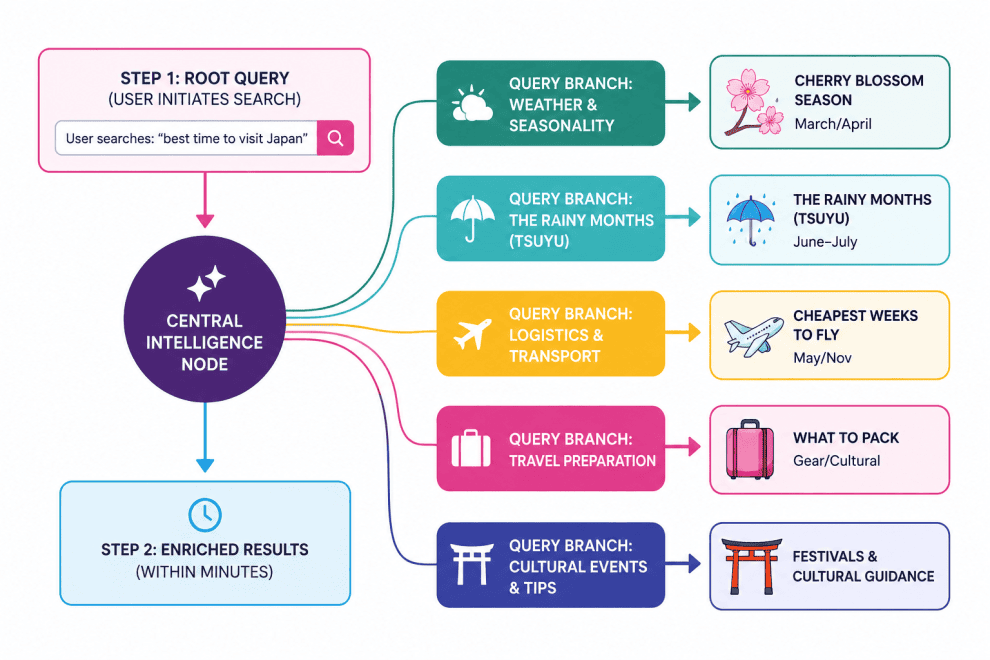
Search engines and AI systems now anticipate that. They take one question, expand it into the cluster of questions around it, and favor the pages that answer the whole cluster rather than the original phrase.
This process, known as query fan out, reshapes what quality content means. A page can mention exactly the right keyword and still leave most of the real question unanswered. The pages that win are the ones that cover the full intent behind a search, and that is a much harder thing to measure at scale. It is the shift Oncrawl’s Content Lens was built for.
When keywords stop being the question
Anyone who has run a content audit on a large site knows how tedious it gets. Pages are templated, boilerplate adds noise, and the issues that matter most stay buried.
You can’t optimize what you can’t isolate, and a traditional audit makes you wade through irrelevant data to reach what counts.
The deeper issue is that most audits still ask the old question. They confirm a keyword is present, a title tag is the right length, the grammar is clean. That confirms a page is technically sound, but it says nothing about whether the page answers what users and AI systems are actually asking.
Content Lens was built to ask that newer question. Powered by AI, it reads your content the way a search engine or an AI system would, and shows you where it falls short of the full intent behind a search. It sets boilerplate aside and focuses on the user-visible, indexable content that decides how a page performs.
How Content Lens scores content for the way search works now
Oncrawl Lenses focus your analysis around real SEO challenges, giving you a sharper, more guided view of how your site performs. Content Lens goes further than a reporting layer and reframes how you think about content performance.
At its core, Content Lens pairs a single global score with detailed insights across five pillars of content quality, ordered by how much they shape performance in modern search:
- Query fanout coverage: Measures whether a page answers the follow-up questions users and AI systems actually ask around a topic, not just the primary query. It is the strongest signal of how complete and citable your content is.
- Relevance and user experience: Assesses overall value, depth, and the engagement signals that show a page genuinely meets intent.
- Meta tags: Examines titles and descriptions for clarity in search results and AI-generated answers.
- Heading structure: Measures whether headings help users, search engines, and AI systems understand the structure and meaning of the page.
- Grammar and spelling: Focuses on whether the page contains major language issues that affect clarity, credibility, or readability.
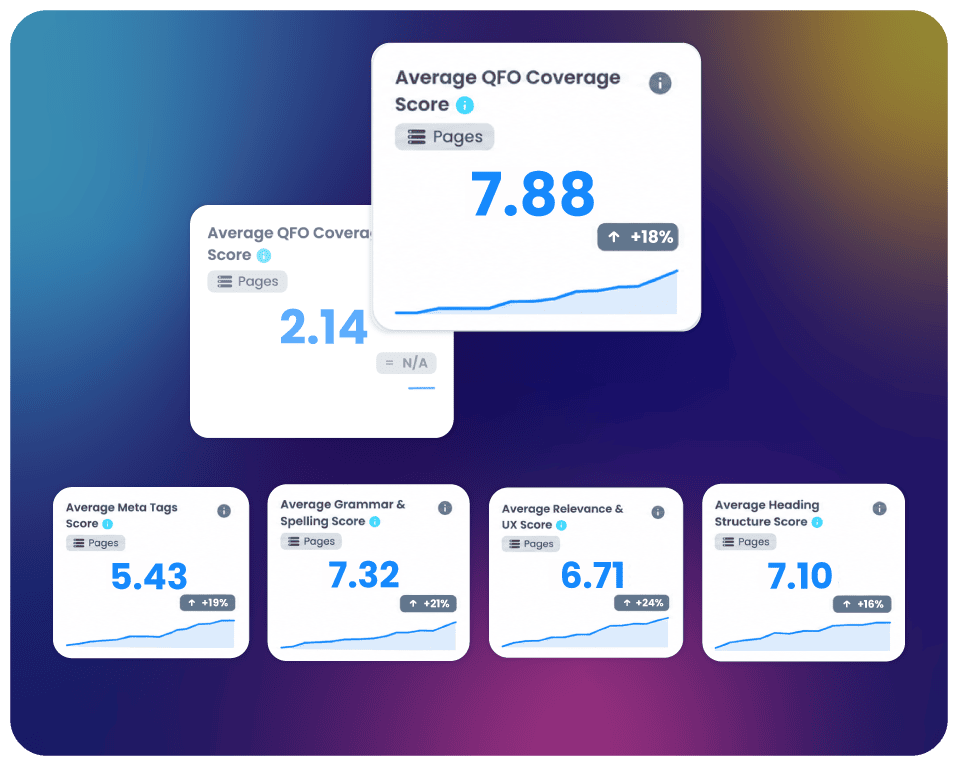
Each page receives a global score from 1 to 10, weighted so the pillars that matter most for modern search, led by query fanout coverage, count for the most.
If a page scores low on query fanout coverage, for instance, it might suggest adding a section that answers the top related questions users and AI systems ask about the topic.
Using Oncrawl’s segmentation capabilities, those insights scale. By analyzing predefined page groups, Content Lens surfaces patterns within sections, templates, or topics that stay invisible when you look page by page.
The Actions for Improvement chart then gathers every page-level suggestion across a crawl into a prioritized list, so you can see which fixes, applied across a whole template, will do the most.
What this looks like in practice
Closing the intent gap on destination pages
Picture a travel platform with a strong “things to do in [city]” template covering hundreds of destinations. The pages rank, but they are slipping in AI-generated answers and losing ground to competitors.
Running Content Lens reveals a consistent pattern: query fanout coverage scores low across the whole template. The pages describe attractions well, but they skip the follow-up questions that define trip planning, like the best time to visit, how many days to spend, how to get around, and where to stay.
The page-level recommendations point straight to those gaps. The team updates the content model for the template, adds the sections travelers and AI systems are looking for, and the destination pages move from simply ranking to answering the whole trip-planning question. The gain comes from covering intent more fully, not from adding more keywords.
Bringing thousands of listing pages up to standard
Now picture a booking site with tens of thousands of hotel and rental listing pages, all built from templates. A manual content audit at that scale is impossible, so quality problems go unnoticed until they surface as lost rankings.
Content Lens scores the full set in a single pass. Segmenting by page group, the team sees the problem is not spread evenly: a handful of templates with thin, near-duplicate descriptions and weak meta tags are pulling down relevance and UX scores across the site.
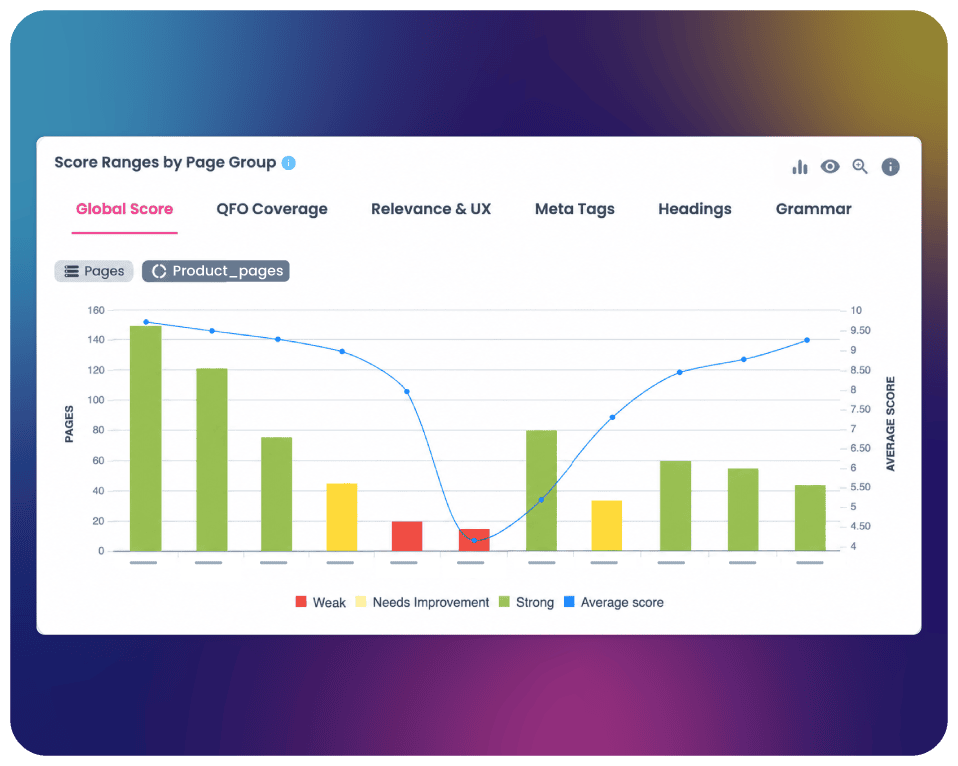
The Actions for Improvement chart prioritizes the fixes that recur across the most pages. The team rewrites once, deploys across the segment, and turns what would have been weeks of manual review into a focused, high-leverage sprint.
Smarter content starts here
The hardest part of any technical SEO challenge is turning analysis into action. Even the most thorough audit is only worth as much as the improvements it leads to.
By combining AI-driven insights, page-level diagnostics, and a weighted scoring system, Content Lens helps SEO teams see what matters most and act on it with confidence.
In practice, that means less time spent diagnosing problems, faster fixes, clearer priorities, and visibility you can measure across both search engines and AI systems.
The pages that win now are the ones that answer the full question, including everything a searcher, or an AI system, asks next.
Content Lens gives technical SEO teams a way to keep pace, whether they are managing an enterprise site or sharpening a focused set of high-value pages, and to move from insight to impact faster.