
There are two main reasons for major enterprise SEO mistakes: silos and scale.
Both arise from the nature of enterprises. Large organizations are built on specialization and separation: departments, systems, markets, tools, product lines. That structure creates silos. And the size of their digital footprint creates scale.
Coming to enterprise SEO from running organic growth solo at a startup, I quickly noticed the unique challenges of large sites and teams.
But enterprises, thanks to their substantial and diverse resources, are well positioned to win in SEO, especially if they handle the following seven common mistakes.
1. Lack of cross-team alignment
Alignment between teams is one of the key challenges of enterprise SEO. You might think an activity belongs entirely with the SEO team, until you discover there are stakeholders across brand, legal, and communications.
As more brands try to dominate AI search, this problem becomes more evident. One of the key optimization strategies for large language models (LLMs) is improving brand and entity consistency across different channels.
An Omniscient Digital analysis of about 23,000 sources cited by AI platforms found that only 23% came from brands’ own websites, while earned media accounted for 48%. For enterprises, new product or feature launches and acquisitions of smaller companies happen quite frequently. The problem arises when only the website gets updated.
That is how a platform like Slack ends up with a homepage that reads “All your people and AI agents working together,” while its Wikipedia entry still describes it as “a cloud-based team communication platform,” with no mention of AI agents.
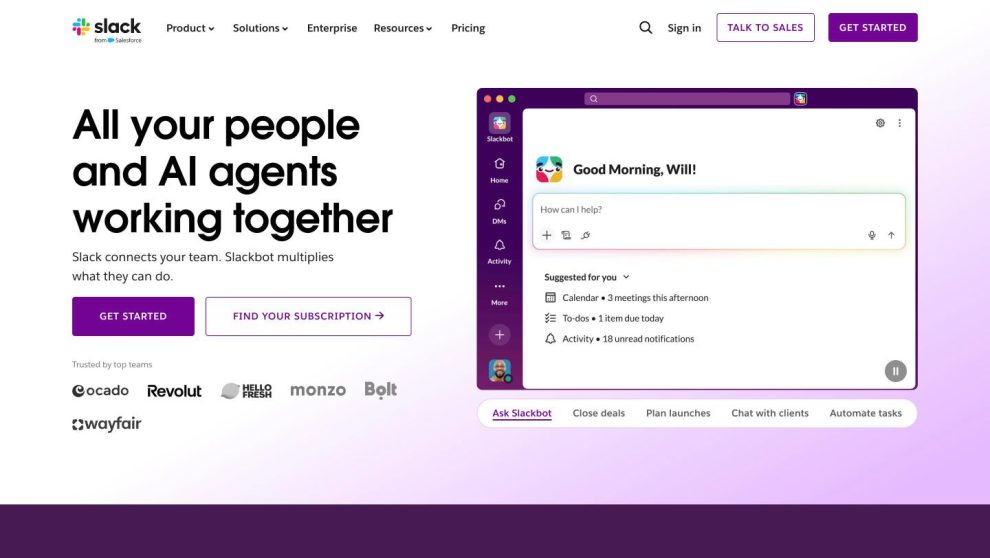
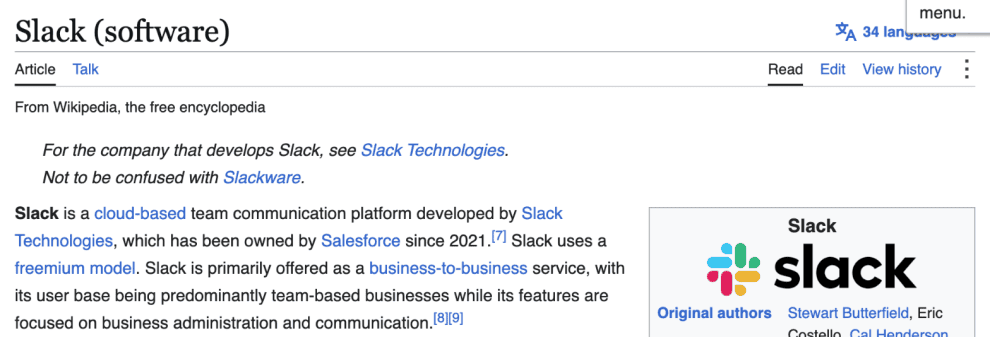
Cross-team misalignment is common for a few connected reasons. Teams often have no visibility into each other’s processes and tools. They are also evaluated against different key performance indicators (KPIs): the PR department, for example, is working on securing media coverage, but does not consider backlinks.
On top of that, cross-team dependencies shift constantly as teams split, merge, expand, or shrink. And projects owned by multiple departments can also be blocked by other teams or fail due to ownership ambiguity.
Solution
☐ Document team processes in a shared knowledge base.
☐ Share SEO KPIs and key projects with related teams, such as paid, affiliates, and PR, every quarter.
☐ Add a step to every project brief that lists which teams’ timelines, staffing, or sign-off it depends on.
☐ Include beginner SEO training in the onboarding of content employees.
2. Unmanaged technical debt
In SEO, technical debt refers to the accumulation of decisions that affect a site’s crawlability, indexation, architecture, and performance. The size of enterprise sites is a multiplier for how much of this debt builds up during site migrations, content pruning, URL structure changes, and more.
Enterprise technical SEOs face a distinct set of challenges here. They often inherit years of historical platform decisions that sometimes cannot be fully traced, and a change in one section of the site can have implications elsewhere: updating the global navigation to add a new top-level category, for instance, can dilute internal link equity.
They also have to prioritize across hundreds of issues that all compete for the same developer resources, while accounting for additional factors, like crawl budget management, that are rarely a concern for smaller sites.
Solution
- Document key website changes and their reasoning.
- Set up monitoring that flags issues as they arise instead of discovering them on the next site-wide crawl.
- Automate repetitive tasks related to canonicalization, redirects, hreflang tags, and similar issues.
- Create content management system (CMS) guardrails for title tags, meta descriptions, slug format, alt text, and more.
- Use a scoring system to prioritize issues based on business impact, affected URLs, resource requirements, and SEO implications.
- Hold technical SEO workshops for teams that make direct changes to the website.
- Add an SEO review step to new page launches.
3. Poor internal linking
Internal linking is “very powerful for large websites,” says Gus Pelogia, Senior SEO Product Manager at Indeed. In a conversation we had, he shared with me that he believes there are usually plenty of relevant internal linking opportunities without forcing irrelevant links just to hit a target.
Pelogia says you can create both simple and complex models to connect semantically similar pages. As he put it, this kind of linking “has a lot of potential to support traffic, visibility, and conversions increase.”
I have worked on small sites where I would add internal links to new pages from memory. That approach does not scale. When a site has thousands or millions of pages, you need a system that supports the site’s evolution across semantic page relationships, link equity flow, and issue detection rather than relying on manual fixes.
Solution
☐ Define concrete internal linking goals (promoting product pages, distributing link equity from external links, and so on).
☐ Measure the authority a page receives from the number of internal links pointing to it and its click depth, and weigh that against your internal linking goals.
☐ Create a list of recommended anchors for internal links to priority pages.
☐ Add an internal linking step to the workflows for new content.
☐ Perform a quarterly internal link audit to maintain site health.
☐ Use methods such as vector embeddings (built in Python, for example) or SERP overlap analysis to uncover and link semantically similar pages at scale.
4. Scaling content faster than quality control
Enterprises typically create content at scale to support different product lines and locales, and many do not produce it all in-house: they supplement with agencies and freelancers.
Add the rise of AI-generated content, which further raises expectations for faster output, and the result is inconsistent content quality, tone of voice, brand messaging, product positioning, and search optimization.
The volume also creates duplicate content and keyword cannibalization. Case in point: according to an analysis by Kamila Olexa, ClickUp applied a nearly identical promotional template across more than 7,000 blog posts, potentially contributing to a 97.6% decline in estimated organic blog traffic over 15 months.
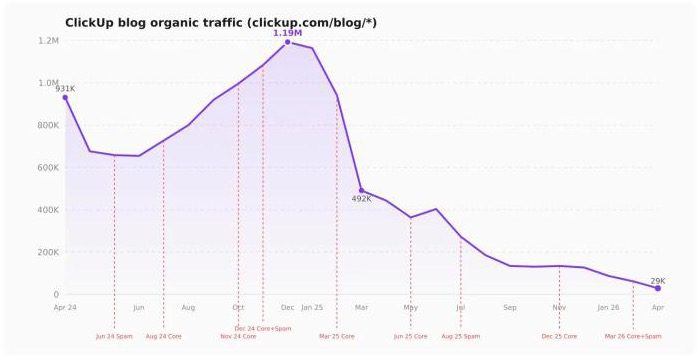
Source: zkami.substack.com
Solution
☐ Create guidelines for brand tone, voice, and formatting.
☐ Build a custom Claude Project or a GPT to run content against these guidelines.
☐ Involve SEOs in content brief creation and quality assurance (QA).
☐ Create a process for AI-assisted content production that prioritizes information gain and alignment with E-E-A-T (experience, expertise, authoritativeness, and trustworthiness).
5. Content decay at enterprise scale
Decay is a natural part of the content lifecycle, and the more enterprises scale content, the more content needs updating. That is why refreshes need to be an integral part of the content production process.
Some content becomes outdated for internal reasons, such as a product rebrand or the launch of a new feature. These cases are arguably easier to tackle, because you know what you need to do: rename all mentions of the product, or add the feature to all relevant articles.
Content also decays for external reasons: new data becomes available, competitor products evolve, Google reranks your content, or search intent for a keyword changes. In these cases, you first need to discover what edits are needed.
Solution
☐ Allocate adequate time for content updates. This depends on your industry, but for enterprise sites, it can take as much time as creating new content.
☐ Plan regular refreshes for your key pages. Check how often the top 10 results for each page’s target keyword change, and create a timeline for your team.
☐ Set thresholds that qualify content for pruning or redirecting, for example, articles that have not converted and received 50 or fewer clicks in the last 12 months.
☐ Create a content refresh checklist for partial and full content updates.
☐ Automate decay detection as much as possible. Consider using the Google Search Console (GSC) API and a script.
6. Weak international SEO strategy
Picture this: an enterprise brand dominates its local market. It also has versions of the site in 50+ languages. But it barely attracts clients from these other markets, because it does not rank there.
This scenario is not uncommon. It tends to happen when most of the company’s employees speak only one language, when the team replicates the strategy for the central market across other markets, or when SEOs underestimate smaller (yet locally established) competitors.
Canva is my go-to example of international SEO done right. It goes far beyond translating pages or localizing text: its marketing messaging, imagery, and design experiences are adapted to different markets. My favorite detail is templates.
Canva has invested in language-specific fonts, developed designs around local aesthetics and cultural preferences, and created market-specific templates that reflect how people actually use the platform.

Source: Creative Culture’s Canva case study
Solution
☐ Ensure hreflang tags are correctly implemented.
☐ Conduct keyword research and competitor analysis for each market.
☐ Involve native speakers, at a minimum at the page QA level, to ensure the content reads naturally and accounts for cultural and legal market specifics.
☐ Train localization specialists in basic SEO best practices.
☐ Build local backlinks and citations.
7. Fragmented reporting
The tech stack for an enterprise SEO team can include Google Search Console, Google Analytics, a keyword research tool, a rank tracker, a technical SEO tool, a backlink monitoring tool, and an AI visibility tracker, all of it siloed. When the same metric shows up across multiple tools, the numbers do not always agree.
In another conversation I had with Peter Rota, Senior Technical SEO Manager at HUB International, he explained that when data is fragmented, “it takes a very long time to compile.”
Before moving to a centralized platform, he recalls the same data point appearing with conflicting values: “When I was reporting on AI Overviews, there were two places to get the data. We weren’t sure which number was accurate.”
Solution
☐ Consolidate data from different tools into a centralized platform that helps you understand how metrics work together and diagnose issues more effectively.
☐ Automate data pulls to reduce manual logging errors and save time.
☐ When the same metric appears across tools, check how each tool calculates it, and designate one as your source of truth, preferably first-party data.
☐ Audit your stack for redundancies to reduce noise and redirect budget.
Start with the mistakes that cost you the most
Silos and scale come with being an enterprise, and neither goes away as the company grows. What you can control is whether they quietly cost you rankings and revenue, or whether you catch problems early.
The same pattern runs through all seven mistakes: knowledge sits with one team or one tool, and nobody has a current view of the whole site. Most of that gap closes when teams document decisions where others can find them and agree on which data to trust.
You don’t need to fix everything at once. Pick the mistake costing you the most today, give it an owner, and put a guardrail in place so it doesn’t come back. Then move on to the next one.