
AI can read most webpages just fine without a single line of schema. Large language models (LLMs) are good at parsing plain text. But reading words and understanding what they mean are two different things and that gap is where structured data still has a job to do.
This article looks at where schema actually changes what an AI system does with your page, where it changes nothing at all, and how to tell the difference on your own site instead of guessing.
AI doesn’t need schema to read your content
Modern AI models are surprisingly good at making sense of unstructured pages. They can pick out products, authors, organizations, reviews, FAQs, and locations without any help. It’s just what these models are trained to do.
So yes, a page with zero schema can still be understood by AI.
What schema does is different. It doesn’t make AI mention your website and it doesn’t push you into an answer you wouldn’t have appeared in otherwise.
Instead, it reduces the chances of your information getting misread along the way. Adding schema is less about getting picked and more about getting represented correctly once you are.
What structured data actually does
Think about a page that lists three pricing tiers, two office locations, several example costs, and a multi-step booking process. A person can scan that page and sort it out in seconds.
AI has a harder job. It needs to pull specific details from the page, understand how they relate to each other, and sometimes compare them with information from other sources.
Researchers found that when the AI couldn’t find a clear answer, it didn’t always just skip it – sometimes it made something up that sounded right but wasn’t actually there.
When there’s no clear signal about which number belongs to which plan or which address belongs to which location, the AI has two options: skip the details or guess. Neither is a good outcome for you.
Schema markup’s real job is to label the pieces of a page, telling an AI system which value is the price, which detail is the location, and which text is the FAQ answer. It ultimately reduces the chances of AI misunderstanding what is already there.
A SaaS pricing page provides a good example of how it works.
If your Starter, Pro, and Enterprise tiers are wrapped in Product and Offer schema with the correct price tied to the correct plan name, there’s very little room for an AI system to mix them up.
How this connects to how AI actually builds an answer
It helps to understand what happens behind the scenes when AI Overviews or chatbots answer a question using your content.
Google has described the process in four rough steps:
- A user asks a question.
- The system decides it needs information from the web.
- It retrieves and reads relevant pages.
- It checks its draft answer against those sources before responding.
That last step is usually called grounding.
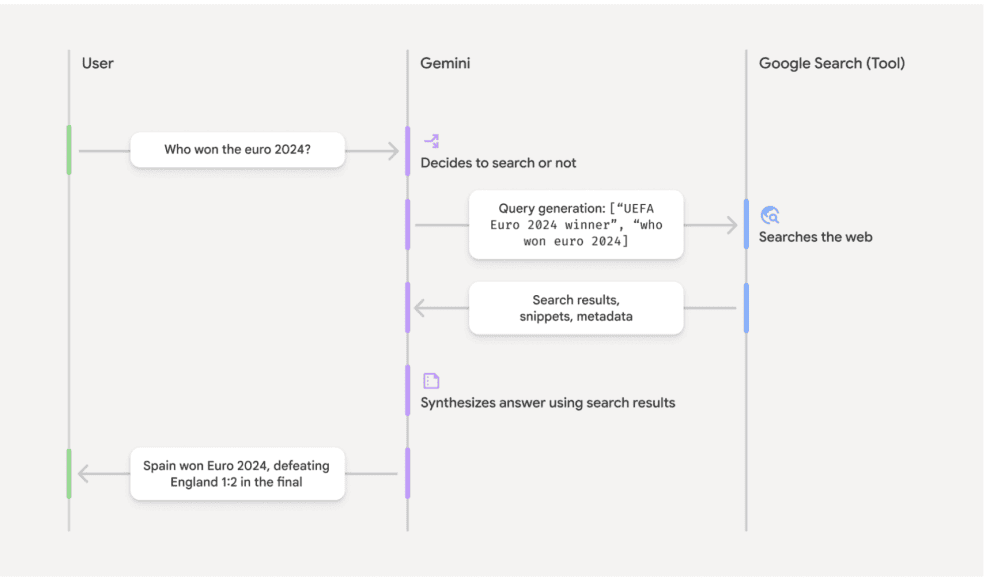
The grounding step is where schema can help. Instead of relying only on its interpretation of a paragraph, AI gets a structured version of your facts.
That’s especially useful for details like:
- Prices
- Ratings
- Business hours
- Shipping information
- Product availability
A general description of your company is usually easy for AI to summarize correctly, but a specific number is different.
For example, imagine a dentist lists “$99 teeth whitening” on one page, “$149 whitening package” on another page, and doesn’t use Product or Offer schema.
An AI system may mention the wrong price because it can’t easily determine which offer is current. With structured markup, you’re connecting the service name and the correct price, reducing the chances of that mistake. It’s the kind of detail where a small misread has a real, visible cost.
AI search runs on confidence, not just comprehension
Here’s another example.
Say a local business has three price points listed across its site, plus a slightly different set of hours on its Google Business Profile. An AI system trying to answer “How much does this service cost?” or “What time do they close?” now has conflicting information to work with.
If your prices and business hours are clearly marked up and match what’s on the page, there’s less uncertainty. If the information is buried inside paragraphs and doesn’t match across sources, AI has to decide which version to trust or avoid giving a direct answer altogether.
According to official Google documentation, the search engine draws on many signals to build programmatic confidence in what a business is and what it offers, including:
- Google Business Profile & on-page content: in Local Ranking Guidelines, Google states that detailed profile data must align with website content to establish accurate search relevance.
- Citations, directories & reviews: the same local guidelines note that Google gauges “prominence” by pulling brand information from external links, articles, and directories, alongside tracking user-generated review count and score.
- External trust validation: in Merchant Center documentation regarding building trust with customers, Google notes that it assesses credibility by actively reviewing “multiple signals from across the web.”
- Schema markup: According to Google’s Structured Data Documentation, schema acts like clear labels on your content so Google’s automated systems don’t have to guess what your page or business is.
None of these signals work alone. Schema is one input among several. When all of these signals point in the same direction, confidence goes up.
When they conflict, confidence drops, and that shows up as vague or missing answers in AI Overviews, local packs, and other AI-driven features.
John Mueller from the Google Search team has said something similar. He’s said some features “really depend a lot on the structured data,” especially things like pricing, shipping, and availability, saying that kind of detail is basically impossible to read with high accuracy from a plain text page.
That is probably the best way to think about schema. It will not win you visibility by itself. What it does is hand over your facts cleanly, the kind that are otherwise easy for machines to misread.
There’s also a variation of the business hours problem mentioned earlier that’s worth addressing: conflicting information across the web rather than within a single page.
Schema doesn’t resolve a disagreement between sources, but it does make your own site one less source of confusion. That may sound like a small win, but it’s an important one because it’s completely within your control, unlike a random directory listing someone created years ago and never updated.
Where schema helps AI the most
Some schema types carry more weight for AI understanding than others:
- Organization – establishes who you are as an entity, your name, logo, social profiles, and how you connect to other pages and mentions across the web. This is foundational, not flashy, but it’s the base layer everything else builds on.
- Article and WebPage – give AI a clearer sense of what kind of content it’s looking at, and who wrote it and when. Useful for freshness checks, since AI systems weigh recency in some queries.
- FAQPage – organizes content into discrete question and answer pairs, a format AI systems can lift directly. Google retired FAQ rich results in May 2026, so there is no SERP feature left to win here. The markup is still valid and still worth using, just for machine comprehension rather than for visibility.
- HowTo – structures step-by-step content so the order of steps stays intact when it’s pulled apart for a summary.
- Product – central for e-commerce and SaaS, since this is where price, availability, and variant details live.
- Person – supports author identity, ties a piece of content to a real person with a track record, and feeds E-E-A-T signals.
Schema remains good technical SEO practice and keeps you eligible for rich results. So it’s a good idea to keep it in place and audit it regularly. Just don’t expect it to have a huge impact on how often you get mentioned by AI on its own.
Schema alone won’t make AI trust your website
Structured data can’t fix thin content, outdated facts, weak topical authority, or poor internal linking. Adding Author schema doesn’t create expertise just like adding Review schema doesn’t make the reviews trustworthy. Structured data only matters if it reflects something real.
If you mark up a five-star rating for a product with a poor reputation, you haven’t fixed the problem. You’ve simply made the mismatch easier to spot.
One industry study found that pages cited by AI systems were almost three times more likely to use JSON-LD schema than pages that weren’t cited. That’s a real number, but it doesn’t prove schema caused the citations.
Sites that implement schema properly also tend to be better maintained overall. They usually have stronger content, more backlinks, and cleaner technical foundations, all the things that independently make a page more citable. Schema might be part of what got them cited, but it could also be sitting on the same sites doing all the other things right. The data doesn’t clearly separate the two.
None of this is a reason to skip schema. It is a reason to be realistic about what schema actually accomplished. The realistic path runs in sequence: better schema improves rich result eligibility, which strengthens organic visibility, which raises your chances of being included in AI-generated answers.
It’s an indirect benefit, not a direct ranking factor for AI search.
How to check this on your own site
On a small site you can eyeball your markup page by page. On a large site with thousands of URLs, the hard part is knowing where schema is missing, wrong, or out of step with what is actually on the page.
Here is where using a platform is useful: crawling the full site, flagging pages where structured data is absent or invalid, and surfacing mismatches between your markup and your visible content so you can fix them before an AI system reads the wrong version. Oncrawl does this across large, complex sites for both search engines and AI systems.
Final thoughts
As AI search grows, accuracy matters just as much as visibility. Schema won’t necessarily get you cited by AI, but it does make it easier for AI to understand your business and represent your information correctly.
If you’re deciding where to spend your time, here’s a short list to work from:
- Prioritize Product and Organization schema first, then Article. Product and Organization cover the facts machines misread most often, prices, availability, and business identity. Article supports authorship and freshness, which AI systems weigh on some queries.
- Audit existing markup for accuracy at least once a quarter, checking that prices, hours, and availability in schema match what’s actually on the page.
- Don’t add schema types just because they exist, add them where they map to real facts about your business.
- Keep focusing on the fundamentals. Strong content, clear site structure, and accurate information give AI more reasons to trust and use your content.
Keep schema on your technical checklist. Optimize it for rich result performance. And let it do what it’s meant to do: make your content easier for search engines and AI to understand.